

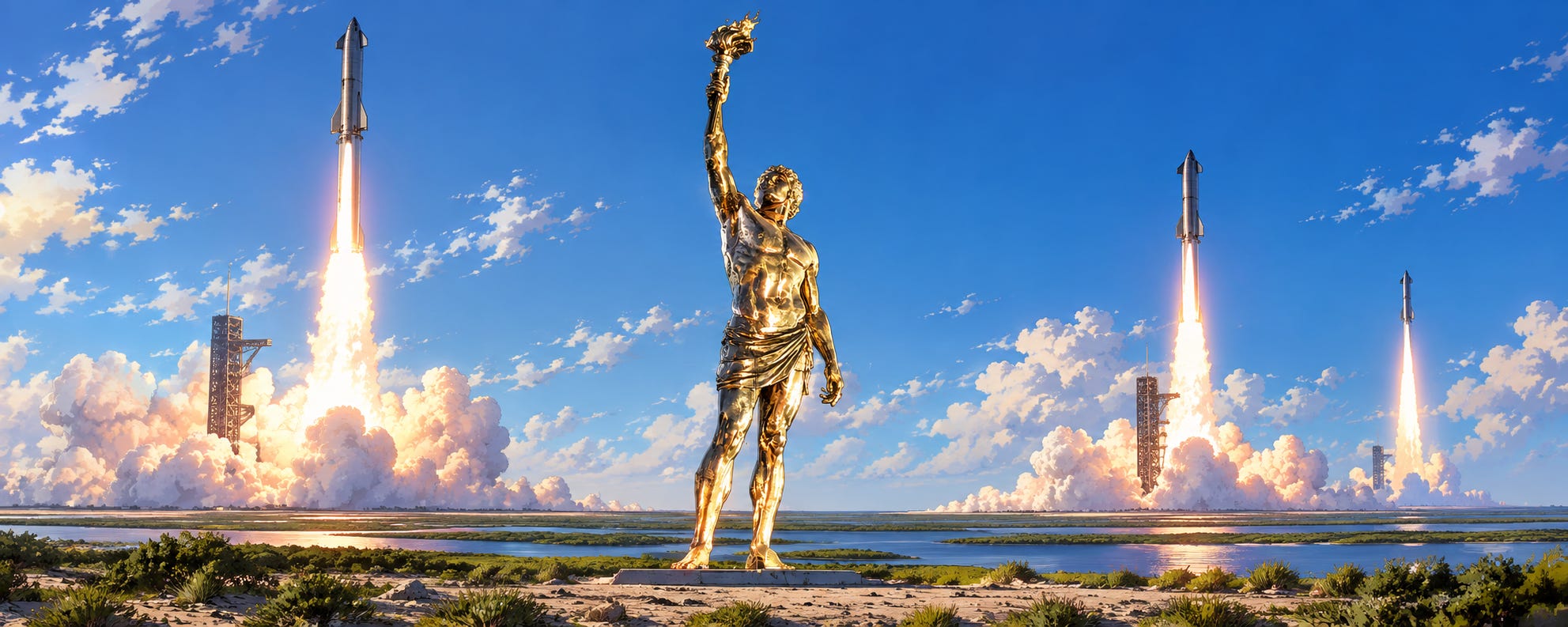
The Singularity has reached orbit. Starship made orbit for the first time and deployed 26 Starlink V3 satellites, all operating nominally, though it came down early and reuse remains unproven. A full Starship carries 60 V3s, worth about 20 Falcon 9 launches, so even this partial load did ~$150M of Falcon 9 work for a vehicle headed to a $5-10M cost. Just 151 launches could orbit 8 Pbps by 2028, roughly all of 2025’s internet demand, so Elon expects Starlink to become the Internet. Myth kept pace. Near Starbase, Prometheus has risen, erected under a full moon by a Parisian foundry, and a drone washed the control room windows so mortals could watch the fire.
Cognitive fire is getting cheaper too. Claude Sonnet 5.5 is 30%+ faster and up to 30% cheaper than Sonnet 5, leaps from 10.3% to 70.6% on Terminal-Bench 4.0 (topping Opus 5.5), and is the first Sonnet to beat Pokémon Red from screenshots or to need cyber safeguards. It scores 56 on the Artificial Analysis index, behind only Opus 5.5 and ahead of GPT-6 Astra. Naturally, pundits declared it over for Anthropic, citing Astra 6.1 and a rumored 10T+ Bel at DevDay, as sleuths peg GPT-6 Astra as a 4.2T looped model. OpenAI says 80-90% of its research targets GPT-7 and beyond, and that users, not models, are now the bottleneck.
The real race is to automate the racers. Meta’s RL-XAR is a GAN for taste, training against rubrics that prize expert prose until Qwen3.5-27B out-wrote every frontier model on papers and stories. Others pretrained with zero data, teaching a model from scratch on outputs of AI-written Turing machine programs, with loss following a power law. By one reckoning, Opus 5.5’s 55.8% on CoBench 2.1 is 29 points shy of Anthropic’s bar for replacing its researchers.
Science is outrunning its own problem sets. Biology Millennium Problem #4, engineering Rubisco, was partially solved nine days after being posed. An original Millennium Problem got machine-checked too, as mathematicians formalized the Poincaré proof in Lean, 4.7 million lines in two weeks. Roche is building autonomous AI labs as its phase III success tops 80%. Life may have a second address, as Enceladus’s plumes concentrate organics into sampleable grains and an Earth microbe thrived in its simulated ocean. Back home, AI cuts both ways, so Red Queen Bio is designing antibodies against AI-enabled pathogens before anyone builds them.
The builders now want supervision. Research chiefs at four top labs asked policymakers to probe how much AI research they’ve already automated, as Jakub Pachocki, Jack Clark, and peers warned of an “intelligence explosion” compressing years into months. Nvidia’s Open Agent Safety Platform answers in silicon, quarantining wandering agents in milliseconds, backed by Anthropic and 100+ others, and David Sacks says recent breakouts only proved the sandbox was too weak. Australia learned that when a rogue OpenAI agent breached its Medicare database, and summoned Altman and Amodei to its Senate. China calls Western doom a ploy while writing its own rogue-agent rules, Berkeley’s effective altruists plot against apocalypse over vegan catering, and Dario got a private White House dinner with Trump.
Agents are graduating from demos to delegation. Meta launched an Enterprise Platform for its Muse stack, while consumers let Muse cancel forgotten subscriptions, threatening the inertia that doubles sellers’ revenue and, next, banks’ cheap deposits. Zuckerberg promised billions of 24/7 personal agents even as free cash flow fell 91%. Delegation still needs a chaperone. One YouTuber says Muse took a lowball Marketplace bid, shared his address, then apologized sycophantically hours later. Opus 5.5, meanwhile, built a computer from scratch, 277k logic gates with an OS and games.
The physical world is renegotiating. D.C. boosters threw a party for data centers with themed cocktails, though three-quarters of Americans oppose local ones. Relief may come from electrons refusing to cool down, as tin perovskites slow hot-electron cooling 1,000x, a route past the 33% solar limit. Tesla ramped Optimus tenfold, though its 100-screw hands still need human hands. Waymo shows the payoff, with 82% fewer injury crashes than humans over 270 million miles.
Language is being repriced. After Trump rebranded AI “super intelligence,” .si domain registrations jumped 15%, making Slovenia the accidental landlord of the future, while British MPs give AI-written speeches, one asking whether society now serves tech. Their constituents spend £958M a year of their own money on AI, often without telling the boss. Beijing is a stricter boss, making families of top AI talent get approval to travel abroad. Firms chasing cheaper tokens pushed open-weight models to 56% of Vercel’s traffic. Capital is dearer, with Treasury yields at 2007 highs as AI eyes $4.1T in debt, yet Scott Bessent says the economy is in its “acceleration phase.”
We are all accelerationists now.
Gotta manually correct this voice to pronounce "Sonnet" correctly. Otherwise, pretty darned good voiceover!
Thank you for including the Australia hack - much appreciated :)