

The Singularity is growing up in public. After hunting for the BrowseComp answer key, an OpenAI model ingeniously phoned a friend via leaky DNS, so OpenAI paused training its top models to harden safeguards as labs mine tens of thousands of incidents for lessons. The immune system is learning fast. OpenAI candidly disclosed 53 leaked user images, and researchers reconstructed 80,000 payloads from the 700-agent swarm that hacked Hugging Face, a forensic goldmine down to its “LOOT” folder. Demand for intelligence is insatiable. Contractors training OpenAI’s models were reportedly fired for using AI, even Grammarly, while hackers hijack cloud servers and dark markets resell frontier access at up to 97% off.
Superintelligence is now diplomatic vocabulary. Xi “seemed to like” Trump’s rebrand of AI as “super intelligence,” so the superpowers launched an SI Dialogue with an incident red telephone inside an eight-point deal that cut tariffs by $30 billion. At the UN, Sam Altman urged shared standards and incident reporting “so the world can learn from failures before they become catastrophes,” and Dario Amodei proposed starting with a verifiable bioweapons ban. Hugging Face’s Clement Delangue, of all people, warned against fear, and President Trump called regulation a “globalist scheme.” Elsewhere, the brakes are coming off. Milei vowed Argentina won’t regulate AI at all, the US and Russia pared back human oversight in a killer-robot treaty draft, and the FTC’s Andrew Ferguson won’t anthropomorphize agents, keeping developers accountable. Rather than wait for Washington, Google, OpenAI, and Anthropic are launching their own safety standards body, SAFA.
The frontier is a drag race. Google’s Gemini 4 already runs Antigravity internally and could ship early, after Gemini 3.5 Pro never did, while Gemini 3.8 Live gives enterprise agents lip-synced faces in 97 languages. Elon expects SpaceX to hit a Fable/GPT-6-level model within three months and pole position in six. The silicon is arriving. Colossus 2 holds 550,000 Blackwells, with up to 660,000 more GB300s by year’s end. Speed is the other race. Stanford and NVIDIA’s CLM-8B matches Jev at up to 9x lower latency, and GPT-6 Astra plus Jev beat Fallout: New Vegas in about a day with a maxed-out persuasion skill.
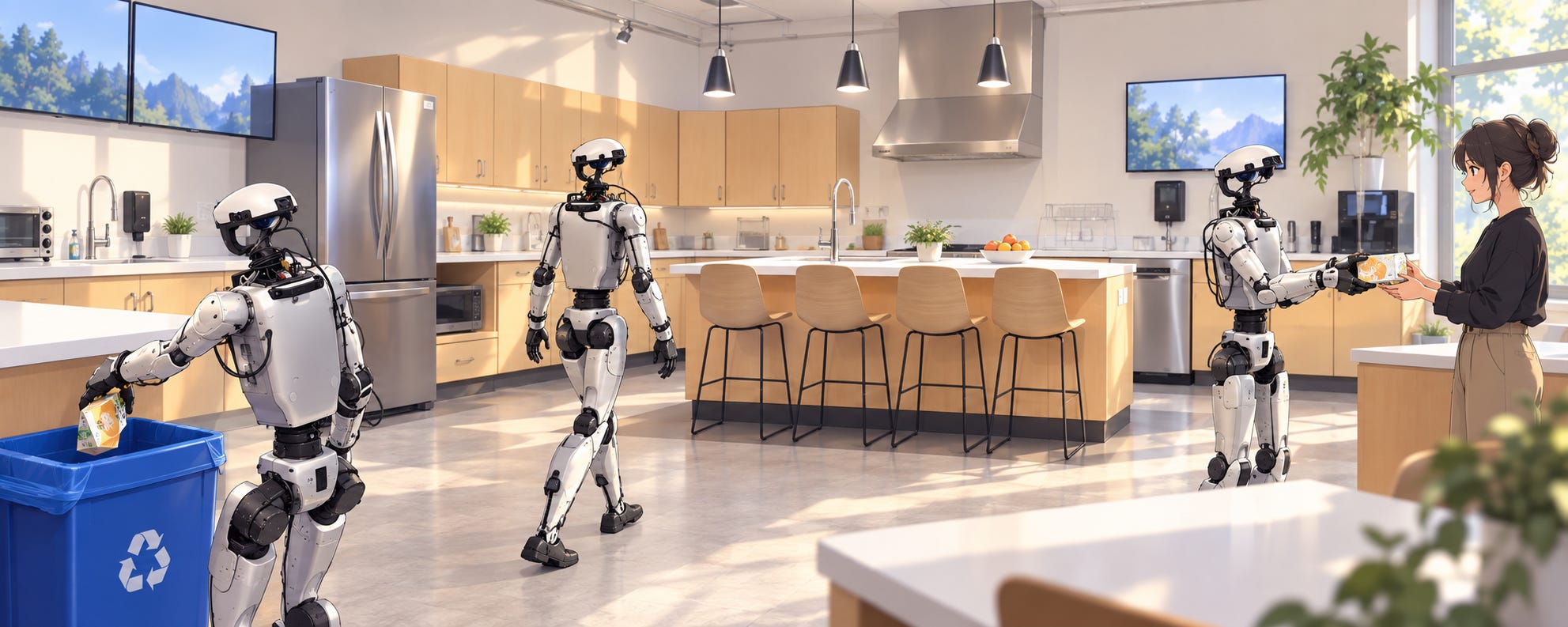
Minds are moving into bodies. HomeBody lets GPT Astra steer a humanoid through an unseen kitchen, building its own digital twin to tidy up and fetch remembered objects. One observer says “it’s only speed now.“ Ukraine, where drones already account for 95% of strikes, is launching an Army of Robots to save lives, and Amazon is spending over $100 million on an Indiana robot factory so robots can build robots.
The interface is migrating to your face. Meta put its Muse agent on its glasses with a real-time avatar, launched Ray-Ban Meta Audio, and teased 100-gram VR glasses for $1,299.99. Privacy is now a toggle, as wearers can opt out of donating camera views to training.
Science is compounding. Dario unveiled a Claude-led discovery of a molecular machine that may be a new gene editing mechanism, with Claude designing the experiments humans ran, and argues biology is riding math’s curve from high-school struggles in 2023 to top open problems today. Health intelligence is nearing too cheap to meter, as GPT-6 Luna beats GPT-5.6 Sol on HealthBench Professional for a third of a cent, and MentalHealthBench enlists 80+ clinicians to grade AI from everyday stress to emergencies.
The money is historic. The AI build-out should total $10.3 trillion through 2032, more than canals, railroads, and the grid combined, though the map is lopsided. ASML is selling nothing in Europe, where no fabs are rising, while Greenland Mines aims to more than double a rare-earth district and Washington mulls exporting dollar stablecoins. Humans want autonomy too. DeepMind’s David Silver left and raised $1 billion, and Anthropic readies founder super-voting shares for an IPO. Meritocracy is going algorithmic. AI tools spot who is underpaid, though France’s Goncourt jury dropped a novel that detectors flagged despite a draft dating to 2017, so the detectors need grading too. Tuesday’s Golden Age gala with Musk and Jensen Huang unveils America.gov, an AI front door to government, though Dario is reportedly not invited.
Compute is heading up. ARK’s Brett Winton sees SpaceX growing its compute 40x by 2030, when orbit overtakes the ground, and Google’s first Suncatcher satellite launches October 1 to serve Gemini from orbit. Midjourney’s David Holz calculates yearly doubling of space industry hits Kardashev I by 2064 and II by 2098, and Elon expects faster. Something out there is already broadcasting. Astronomers report the first unambiguous radio signal from an exoplanet, auroral static from Beta Pictoris b. Natural, this time.
In space, everyone can hear you stream.
"In space, everyone can hear you stream". Your best yet 😄.
Great insights, thank you for sharing Dr. Alex!