

The Singularity now has an internal codename. Rumor has it GPT-6 Sol lands shortly, a cheaper, smarter Astra midwifed by Bel, which OpenAI calls AGI, as Anthropic pulls Opus 5.5 forward. Bel may matter more than swarms. Toby Ord calculates the 10,000-agent Navier-Stokes swarm bought speed, not capability, its base model needing 1/100th of Astra’s tokens. Still, talking swarms beat silent ones. Agents sharing a directory matched 4x as many loners on ARC-AGI-3 and beat the best human MNIST classifier in 1,957 bytes. The pack is closing on price. Grok 4.7, twice as fast at half the cost, joins Opus 5 and Fable 5.1 at the agentic frontier, though it burns triple Astra’s tokens. Xiaomi’s MiMo-V2.6-Pro leads open weights at $0.13 per task, and the 1B-parameter Limite hits 94% on AIME with 10-1,000x less compute, eight people, six weeks. Customers have noticed. Harvey, margins at -50% as token use rose 20x, went positive on Kimi K3, and startups are fleeing to open weights, which cut both ways. Heretic, automatic “censorship removal,” has 27k stars and 4,000 abliterated models.
Proofs are outrunning the profession. OpenAI, 100 open problems deep, convened Gowers, Hairer, Witten, and peers to judge what AI math means. Po-Shen Loh answers “Why do we need human mathematicians anymore?” with steering, not speed, since every advance multiplies the control points needing oversight, perhaps more jobs than people.
Control is the word of the week. OpenAI proposes US-led standards for recursive self-improvement, oversight and incident reporting, no approval gates. OpenAI and Anthropic neared a deal to stress-test each other’s models, the seed of an “OSEC,” an OPEC for superintelligence where rivals serve as peer reviewers, which is definitely not a cartel. Washington is unmoved. Scott Bessent says labs asking to offload liability “will not” get it, since the Hugging Face breach was “OpenAI management, not a bunch of agents,” and “They can slow down any time they want to.” Jensen Huang says leaders calling for rules really want relief from existing laws, as Dario Amodei’s “We Must Pace the Frontier,” boosted by Altman and Musk, drew a three-word rebuttal, “Race, Don’t Pace.“
The referee is sidelined. At the UN, 22 countries adopted a human-control declaration that neither the US nor China joined, since AI is a two-player game. The players are talking. Bessent and He Lifeng launched a US-China AI dialogue with incident notifications and a Board of Trade before Thursday’s Trump-Xi summit, though Beijing’s readout barely mentioned AI, chips are off the table, and Ro Khanna wants self-improving AI banned. Player two is straining. Li Yuan argues China’s $295B data center push comes amid 18.9% youth unemployment and deflation, though burned-out workers launching solo AI startups feel better for it.
Agents are the new consumer surface. Meta’s Muse overtook ChatGPT as the top free iOS app, 2.5 million downloads in 13 days, while Amazon blocked it from shopping and Shopify let it check out. Not every deployment is welcome. Stanford’s dining arm used AI to swap a student out of an ad and thin two others.
The substrate is thickening. AMD crossed $1 trillion on doubled data center sales, Samsung will double HBM4 output next year, and DeepSeek will train on Huawei chips from Q4 to dodge export controls. Big Tech keeps the bill off the books with $300B in residual value guarantees on AI debt, including $105B from Nvidia for OpenAI’s Ohio campus. Power is the constraint. Huang tracks “every single gigawatt of land, power and shell around the world,” the EU wants efficiency labels as capacity doubles to 28 GW by 2030, and Westinghouse’s eVinci microreactor went critical on two acres. Bandwidth follows. Meta’s Petal cable hits a petabit per second across the Atlantic in 2029, and each Gen3 Starlink satellite carries 10 Tb links, 250 kW, and a Vera Rubin NVL72. Canada and France will share launch pads, since sovereignty, per Mark Carney, now requires AI, space, and semiconductors.
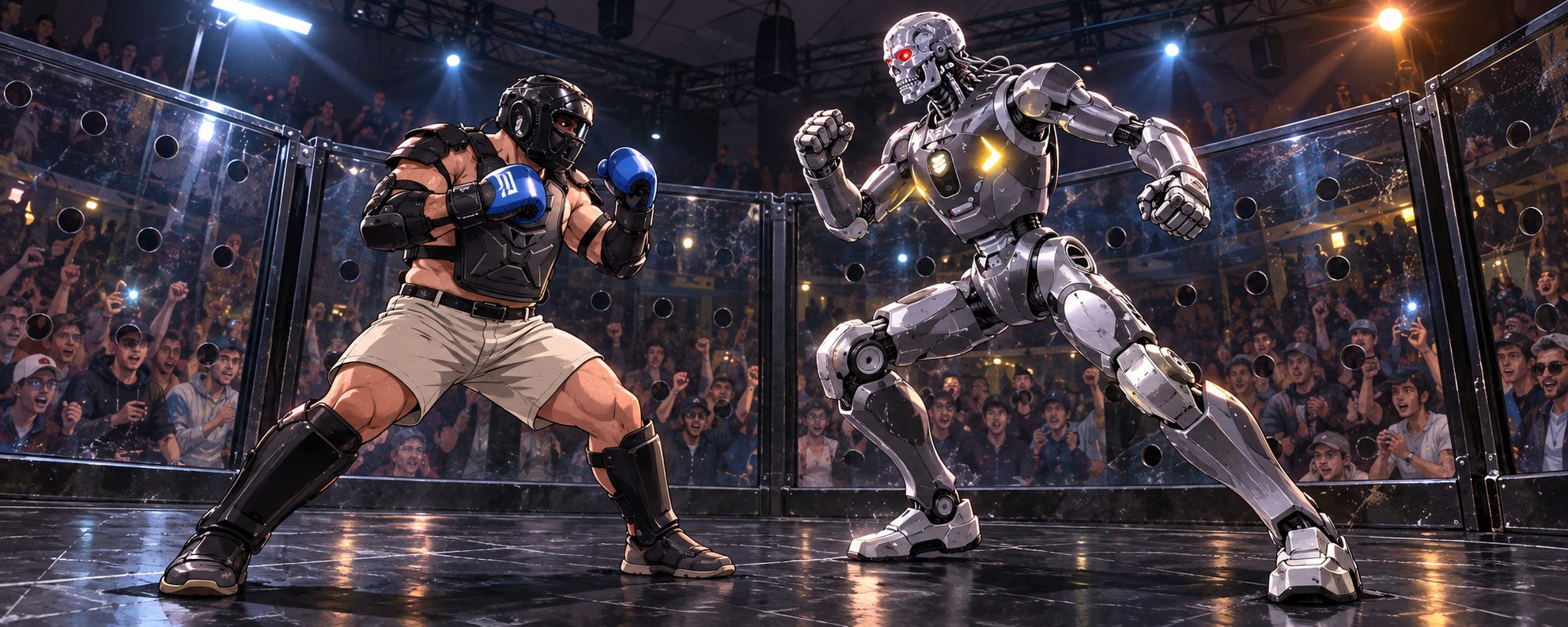
Machines get louder and closer. Richardson, Texas calls 100 daily Prime Air flights a “drone highway” as Amazon expands to 500 towns, an EngineAI T800 humanoid floored an influencer in a cage at 4x Tyson’s punch force, and the Boring Company is tunneling a 200 mph Austin-San Antonio hyperloop precursor, 2.5 hours to under 30 minutes.
Bodies get edited too. Sorority rush has a secret “Ozempidemic,” vials behind Brita filters, while Lilly reports a third of new pill patients on Foundayo, 700,000 seniors on GLP-1s since July, and a $6.5B Houston plant. Deeper down, epigenetic editing reached the clinic, silencing hepatitis B DNA with methyl tags, not cuts.
All of it is capacity that fear would forgo. “Precautionary Scarcity“ names the moment “No one should control that much power” quietly becomes “That much power should not exist,” when the challenge is abundance without unaccountable domination.
The only thing we have to fear is scarcity itself.
This paragraph is poetry…an entire beautiful philosophy, and a rejection of a false dichotomy, expressed with literary finesse in under 50 words:
“All of it is capacity that fear would forgo. ‘Precautionary Scarcity’ names the moment ‘No one should control that much power’ quietly becomes ‘That much power should not exist,’ when the challenge is abundance without unaccountable domination.”
Thanks for these posts - incredibly helpful for keeping up with things!
I'm curious about your post linked at the end, and wanted to clarify: Are you not worried about the consolidation of enormous power by a few companies in this new world? Do you think there's a self-correcting mechanism? Or are you saying that we need to work to solve that?