

The Singularity has signed a 30-year lease. Alphabet, Meta, Microsoft, Amazon, and Oracle disclosed more than $3 trillion in combined commitments for leases, buildings, power, and gear, led by Google at over $1 trillion, nearly eight times last year’s figure. Now the bankers are reading the fine print. Lenders who once funded the build-out with few questions are demanding tougher terms, wary of delays, slower AI profits, and a glut of AI stock and bond offerings. Even the frontier is tightening its belt. OpenAI reportedly cut its round to about $20 billion at a $1.25 trillion valuation, down from $30 billion at $1.4 trillion, as a tech sell-off and Anthropic’s imminent IPO at $1.5 trillion or more compete for investors. A trillion here, a trillion there, and pretty soon you’re talking about real compute.
The binding constraint is increasingly local. A surprisingly bipartisan backlash against data centers is growing in Arizona, which just lost nearly 30% of its Colorado River allotment, yet TSMC’s Phoenix fab, welcomed for its 3,500-plus jobs, uses more water in nine days than the contested Project Blue will in a year, and farms still drink about 70%. So the build-out is chasing the wind. Envision plans to finish its 3-GW Galaxy Campus in Inner Mongolia by 2028, with 10 GW more eyed abroad. Where the wind won’t blow, aerospace will. Boom’s Overture airliner will miss its 2029 target, says United’s CEO, as Boom pivots to 42-MW gas turbines for data centers. Supersonic dreams, it turns out, make excellent subsonic electrons. Even fission is winning converts, as the Green Party of England and Wales dropped its longstanding opposition to nuclear power.
Power is only half the bill of materials. Flash makers like Kioxia, long bullied by Apple into steep discounts, are finally gaining leverage as hyperscalers gobble up supply. Sam Altman wants your memory in the cloud too, calling it “quite terrible” that scarce DRAM sits in home PCs idle 95% of the time, to the horror of enthusiasts running local AI. Your RAM, it seems, is an underutilized asset on someone else’s balance sheet.
If memory is rationed, bandwidth is metered. French lawmakers voted 11-10 for a €0.055-per-gigabyte levy on content giants like Google and Netflix that backers say could raise €10 billion a year. Germany is approaching from the labor side, with Family Minister Karin Prien backing a tax on AI revenue to cushion job losses. Economics 2.0 is installing tollbooths.
Proving you’re human, meanwhile, is becoming a full-time job. AI detectors like Pangram now deliver the final verdict in publishing scandals, so writers are purging “tells” like em dashes, the rule of three, and “delve,” and linguists hear a hybrid human-machine dialect emerging. Faking humanity, on the other hand, pays tuition. The DOJ charged five people in its first broad crackdown on “ghost students,” stolen identities that let AI file FAFSAs, do coursework, and attend virtual classes, tied to $32 million in losses. The flesh-and-blood humans of San Francisco are running romance like a growth funnel, with “996” founders treating dates as final-round interviews and paying coaches up to $5,000 a month to lift their “conversion rate.”
The body is being refactored too. Eli Lilly’s Q3 revenue jumped 39% to $24.4 billion as retatrutide hit about 28% weight loss and obesity profits began bankrolling gene editing, cell therapy, and cancer. GLP-1s are even solving logistics. Hundreds of UK offshore workers are using weight-loss jabs to get under a new 124 kg helicopter limit set by what rescue winches can lift.
Helicopters have weight limits. Whatever is circling America’s reactors apparently has none. FOIA’d regulatory reports log 67 drone incidents over 28 nuclear sites, including Virginia’s Surry plant near Langley, every one “Closed Unresolved.” Farther out, our oldest emissary runs on thrift. Voyager 1 reaches one light-day from Earth on Nov. 18, after swapping three heaters for lower-power versions to stretch its plutonium and shrugging off a 48-hour blackout. Hubble needs a lift of its own. NASA is asking companies how they might boost Hubble to a safer orbit, service it, or deorbit it by 2032, though nobody has budgeted the trip.
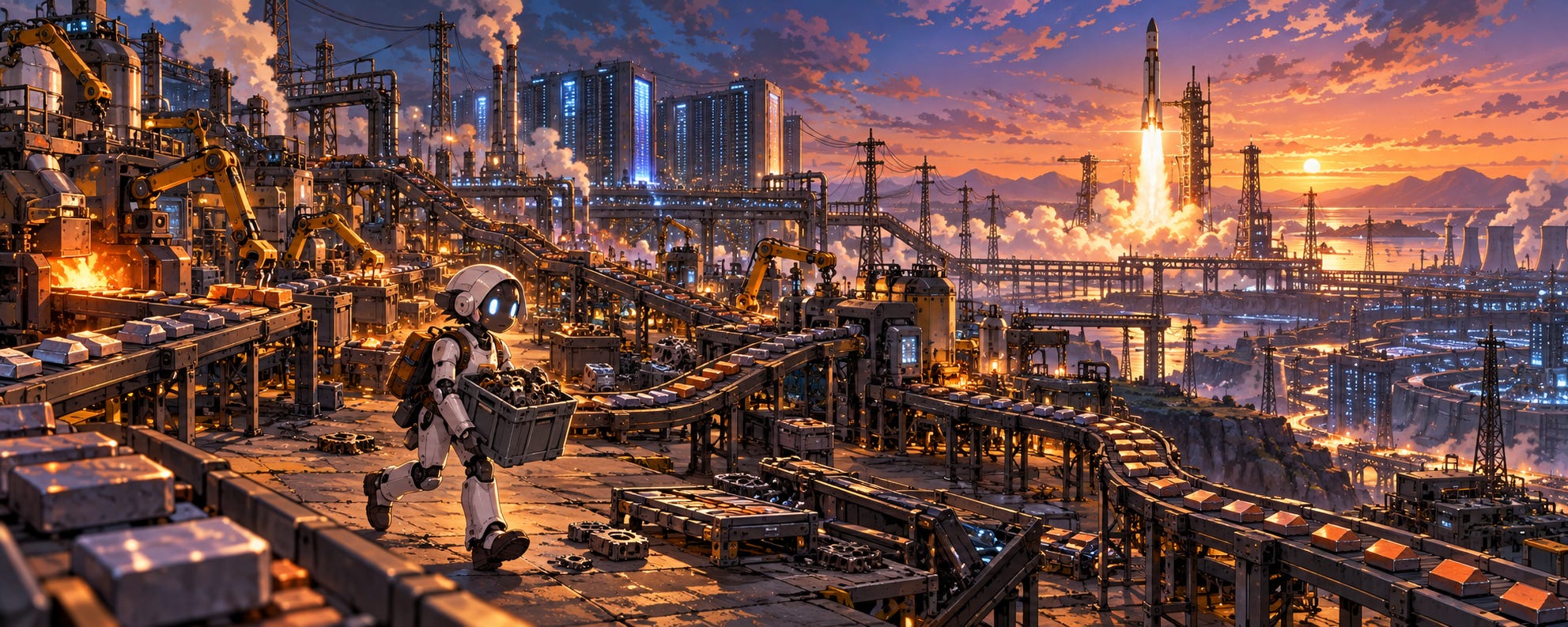
Back on the ground, the machines are getting bodies and chores. Meta reportedly built Max, a 5-foot humanoid prototype, with China’s Fourier in three months as the physical form of its Muse agent, even as the FCC moves to tighten Chinese humanoid imports. The agents are learning to build, if not yet to plan. Ryan Madden got GPT-5.6 Sol to finish a peaceful Factorio run in 13.5 game hours, a leap past GPT-5.5, which never mastered belts, though Sol reached the rocket only by hand-ferrying supplies between production lines it failed to connect.
Out of the crooked timber of superintelligence, a rocket was nonetheless launched.
Please provide lower speed play options - The contents is densely packed and I struggle to keep up while absorbing the implications without losing attention.
What now, backyard smelters for the War effort? Sam wants my RAM? Years ago with a desktop, easy. (Thanks for the fun and enlightenment as always.)