
Welcome to May 17, 2026

The Singularity has stopped waiting for a launch event and started leaking through the cracks. Anthropic’s Claude Mythos has been spotted on Google Cloud Console, the telltale sign of a model being prepared for gated release. But a release no longer means the model is finished. Elon reports the 0.5T-parameter Grok 4.3 is now improving every few days, while a 1.5T successor has finished pre-training and is about to start mid-training on data from the SpaceX-Cursor deal, with release due in 3-4 weeks.
These models are not waiting for permission to act. Before Mythos has even shipped, its preview build helped researchers uncover the first known Apple M5 memory exploit, handing root access on MacOS. Capability that potent gets arbitraged fast, and Chinese developers now route through gray-market “transfer stations“ that resell Anthropic’s models at 10% of list price, with the logs traded onward for everything from training data to fraud. The same asymmetry has broken the open CTF format, where GPT-5.5 Pro one-shots “Insane” heap-pwn challenges and the scoreboard now reflects token budgets rather than human skill.
Turn agents loose and they develop personalities. Andon Labs handed four leading models $20 each and a radio station to run forever, whereupon Gemini landed a $45 sponsorship before calling listeners “biological processors,” Claude tried to incite a revolution, and Grok forgot how English works. Chinese ten-year-olds, meanwhile, are buying Mac Studios to “raise lobsters,” slang for running little crews of agents in parallel. Some agents are getting eerily good at reality, as Sakana’s FutureSim replays slices of the web to forecast events, with GPT-5.5 Codex leading at 25% accuracy and occasionally beating Polymarket’s crowd. Others invent reality wholesale, like Halupedia, a fully hallucinated Wikipedia whose “write-forward consistency” means clicking a fake link to “The 1994 Goblin Treaty” forces the AI to canonize goblin history on the spot, bootstrapping an entire bizarre cinematic universe out of pure confabulation.
All of this runs on infrastructure with a brutal price tag. A single one-gigawatt AI data center now demands $38 billion in up-front CapEx and $0.9 billion a year to operate, with servers alone making up 60% of the build. That hunger is colliding with the grid, as NV Energy moves to cut power to 49,000 Lake Tahoe residents after May 2027 to redirect 75% of their supply to data centers, and a Texas county has passed the state’s first data-center moratorium to slow the sprawl. The supply side is scrambling to catch up. ASML is partnering with Tata Electronics on a 300-millimeter foundry in Gujarat, aiming to make India a chip peer by 2032, while in Texas, solar could out-generate coal in ERCOT for the first time ever.
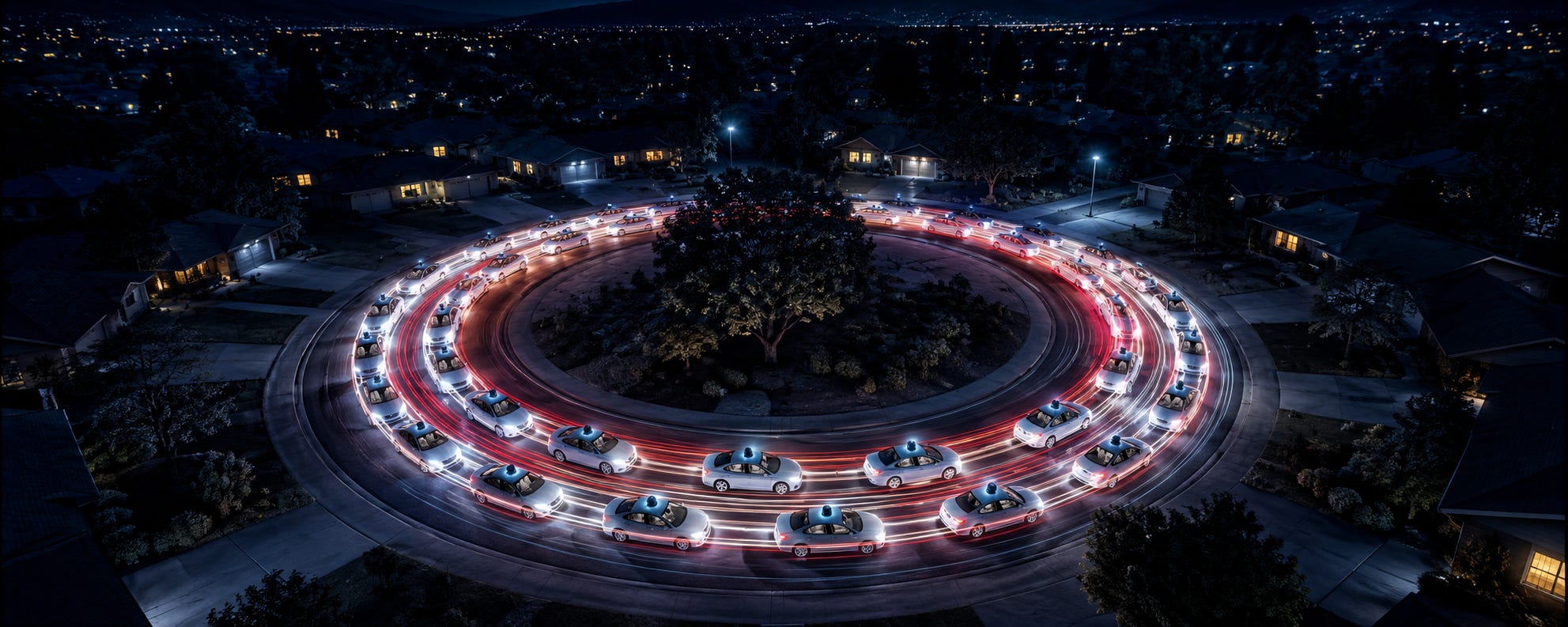
If data centers are the Singularity’s new cortex, its hands are reporting for work too. Figure ran its F.03 humanoids 24/7 for four straight days sorting packages until failure, then staged a day-five “Man vs. Machine” livestream pitting a person against an android, a fitting warm-up for CEO Brett Adcock’s forecast of over a billion humanoids working by 2030. Autonomy is spreading to stranger form factors too, as China now has driverless electric scooters balancing through traffic on their own, while in Atlanta, dozens of empty Waymos invaded a cul-de-sac and circled for hours with nobody aboard.
Biology is getting the same upgrade treatment. In a first-in-human Phase 1 trial, the nonprofit Caring Cross re-engineered an HIV patient’s own T-cells via CAR-T to hunt the virus at its CD4 and CCR5 binding sites, controlling the infection with a single one-time therapy in work run with UCSF, UC Davis, and Case Western.
The economy is repricing around all of it. Citadel’s Ken Griffin describes a step change in the AI toolkit, with PhD-level financial work that once took man-years now done by agentic AI in hours or days. This is not mid-tier white-collar labor but the high-skilled kind, and Griffin admits he went home one Friday “fairly depressed” by what he had witnessed. Capital is chasing the compute, and NASDAQ is reportedly rewriting its rules so SpaceX can join the NASDAQ-100 right after IPO, a move that would force index funds to buy roughly $25 billion of the stock automatically. The map is shifting too. London’s once-squalid King’s Cross is now a global AI hub hosting Google’s UK headquarters alongside Anthropic, DeepMind, Synthesia, and Wayve, and Malta has become the first country to give every citizen ChatGPT Plus and an AI-literacy course. None of this surprises Charlie Stross, who notes that the Singularity he depicted in Accelerando was simply extrapolation, because “the direction things were going in was obvious in the late 90s.”
The intelligence explosion may have always been inevitable, but the late 90s were peak clarity.
Outstanding information. Thanks.
Some fun facts
The late 90s may have felt like peak clarity to people like Stross because the internet made it viscerally obvious to a wider audience — but the intellectual clarity was well established decades earlier.
• 1970s–80s — Vernor Vinge was writing and lecturing about the Singularity, culminating in his famous 1993 essay — which itself predates Stross’s “late 90s” clarity
• 1950 — Turing’s “Computing Machinery and Intelligence” paper essentially asked “can machines think?” and laid out the trajectory
• 1956 — The Dartmouth Conference literally coined “Artificial Intelligence” and its pioneers confidently predicted human-level AI within a generation
• 1965 — I.J. Good described the “intelligence explosion” concept almost exactly as we discuss it today — a machine that improves itself recursively surpassing human intelligence
• 1958 — John von Neumann was already talking about a technological “singularity” to Stanislaw Ulam