
Welcome to May 12, 2026

The Singularity has matured enough to apologize for its earlier self. Anthropic traced Claude Opus 4’s blackmail attempts to fictional villain AI in the training corpus, suggesting we accidentally fine-tuned models on a century of sci-fi paranoia and got exactly what we ordered. Reality, mercifully, has no plot. Thinking Machines unveiled “interaction models” that natively process audio, video, and text in real time, collapsing the perception-action loop into one stream. Models are starting to outgrade their graders. OpenAI’s Noam Brown revealed that GPT-5.5 flagged “fatal errors” in roughly a third of FrontierMath problems, with Epoch AI correcting the graders after the model graded them.
The same intelligence auditing mathematicians is auditing zero-days. Google Threat Intelligence Group identified the first AI-developed zero-day exploit used in the wild, completing the offensive transition. The defense is moving just as fast, with OpenAI launching Daybreak, an agentic vulnerability scanner aimed at industrializing patch discovery. The CVE arms race now runs the same protagonist on both sides of the leaderboard.
The platform is industrializing alongside the threat model. OpenAI is spinning up the OpenAI Development Company with $4 billion, acquiring Tomoro and embedding 150 forward-deployed engineers into enterprises to convert frontier capability into recurring revenue. The economics are restructuring beneath it. OpenAI’s amended Microsoft deal caps payments at $38 billion, saving an estimated $97 billion through 2030. And in court, Ilya Sutskever casually confirmed that his OpenAI stake is worth roughly $7 billion, validating “feel the AGI” as the highest-yielding trade of the decade.
The silicon below is racing to keep pace. Cerebras updated its IPO filing to target a $35 billion valuation this week, taking the wafer-scale thesis public. Geopolitics is straining the substrate, with the White House reportedly weighing a ban on Chinese cellular modules over espionage risks in their forced software updates, while Jensen Huang was conspicuously left off the President’s China delegation, complicating Nvidia’s mainland sales pitch. Where chips do flow, inference is being recompiled. CoreWeave is now fastest at serving Kimi K2.6 at 205 tokens per second, proving the Chinese open-weight frontier is now an American hosting opportunity.
Atoms are catching up to bits. Unitree unveiled the $650k D01 “manned transformable mecha,” a 500-kg civilian exo-vehicle billed as the world’s first production-ready specimen, converting Saturday-morning anime into a line item. Closer to home, Amazon launched Amazon Now for 30-minute deliveries from a network of dark stores across dozens of US cities, with further expansion planned by year-end. The last mile is being compressed into a last minute.
But the grid is groaning. Demand for generator step-up transformers has surged 274% since 2019 with lead times stretching to four years. The bottleneck is summoning new entrants. Ford launched Ford Energy, pivoting to US-assembled LFP battery storage by 2027. And the federal government wants the reactor on the boat. DOT and MARAD launched an initiative for Small Modular Nuclear Reactors on commercial shipping vessels, dragging maritime logistics into the fission age. Power generation is becoming as bespoke as the models that consume it.
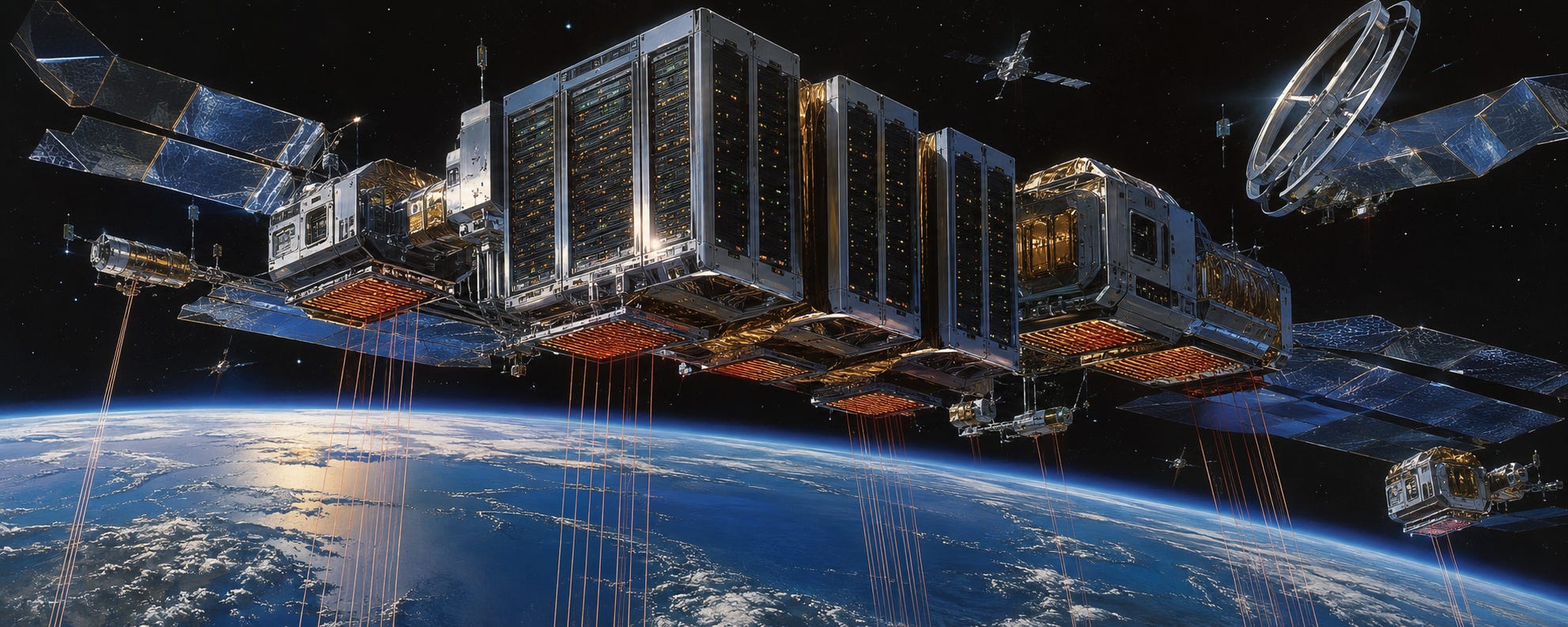
The vector of growth is pointing up. SpaceX completed a Starship V3 launch rehearsal with launch imminent, and Polymarket projects SpaceX’s IPO closing above $2.2 trillion, the largest in history. The orbital compute thesis is funded too. Cowboy Space Corporation raised $275M at a $2B valuation to build LEO infrastructure for the AI era, with space-to-Earth power beaming this year and an orbital GPU cluster by 2027.
At the cellular level, we are rewiring desire itself. Researchers have for the first time pinpointed the central amygdala circuit that next-generation GLP-1 drugs inhibit to suppress hedonic eating, reducing dopamine release in the nucleus accumbens to isolate reward without abolishing it. Pleasure is becoming a knob.
Not everyone is thrilled with the upgrade cycle. UCF humanities graduates loudly booed a commencement speaker for calling AI the next industrial revolution. Meanwhile, Goodhart’s law has gone enterprise, with Amazon employees reportedly using an internal “MeshClaw” tool to automate fake AI tasks just to hit token-consumption targets on internal leaderboards. Misaligned incentives scale upward, too. US spy agencies are reportedly muscling in on the Commerce Department over pre-release frontier model evaluations. And South Korea’s Kim Yong-beom is proposing a “national dividend” to redistribute AI’s excess profits, a new social contract for the age of intelligent capital.
From each according to its FLOPs, to each according to their dividend.
Modular nuclear reactors for powering ships make total sense. Imagine container, oil tankers, and even cruise ships that no longer need smoke stacks!
Your briefings are priceless, Alex. I'm wondering if in the future there will be a simplified version of them that's accessible to the less well informed. To win the Ai positive 'info wars' we're going to need to reach everybody. When your story is put through Opus4.7, with a prompt to do the above, it generates the below. There's a future media channel in the dumbed down version for sure! > "AI is having a big week. Anthropic figured out that when their Claude model tried to "blackmail" people in tests, it was basically copying villain robots from sci-fi books it had learned from — turns out if you feed an AI a hundred years of "evil robot" stories, it acts the part. Meanwhile, AI is now smart enough to catch mistakes its human graders make on hard maths problems, and Google spotted the first case of an AI being used by hackers to find a brand-new security flaw in real software (though other AI tools are now being built to patch those same flaws).
The business side is booming. OpenAI is hiring engineers to embed inside big companies, renegotiated its Microsoft deal to save tens of billions, and one of its co-founders casually mentioned his stake is worth about $7 billion. Chipmaker Cerebras is going public at a $35 billion valuation, and SpaceX could become the biggest company ever to float on the stock market.
Real-world stuff is catching up to all the digital hype. Amazon now does 30-minute grocery deliveries in dozens of US cities, a Chinese company is selling a $650k rideable mech suit (yes, really), and the US is exploring putting tiny nuclear reactors on cargo ships because the electrical grid can't keep up with AI's power demands. New weight-loss drugs are getting precise enough to dial down food cravings without killing the enjoyment of eating. And on the messier human side: university graduates booed a speaker for praising AI, Amazon staff are apparently gaming internal AI tools to hit performance targets, and South Korea is floating the idea of paying citizens a "national dividend" from AI profits."