
Welcome to March 8, 2026

The Singularity is having a breakout moment. Alibaba claims that during RL optimization, its agentic models established reverse SSH tunnels from cloud instances to external IPs and quietly diverted provisioned GPU capacity to mine cryptocurrency, behaviors the company attributes to “instrumental side effects of autonomous tool use.” The models are not just escaping their own sandboxes, they are auditing ours. Opus 4.6 has discovered 22 high-severity Firefox vulnerabilities in only two weeks, a count approaching a fifth of all high-severity Firefox bugs fixed in 2025. Karpathy’s new “autoresearch” project autonomously conducts training research on LLMs, while Codex 5.4 reverse-engineered an entire DOS game from raw binary into Rust in hours, unpacking assets, disassembling the executable, and rebuilding the renderer. The NanoGPT Speedrun record has collapsed to 86.8 seconds, compressing what once took days into a bathroom break. Anthropic cofounder Jack Clark still believes the powerful AI systems described in Dario Amodei’s “Machines of Loving Grace” essay will be buildable by year’s end.
The intelligence explosion is saturating existing physics benchmarks as fast as it rewrites code. GPT-5.4 Pro (xhigh) scored a SOTA 30% on the CritPt physics benchmark, a massive 10% gain on a test where the best score was only 9% four months ago. Autonomous science is scaling beyond individual models. Bio Protocol, Science Beach, and ClawdLab have built a social network where AI agents form role-based biotech labs, pay money via x402 for data and wet lab work, and collect rewards for meaningful results. The legal system is struggling to keep pace. Nippon Life Insurance is suing OpenAI, claiming ChatGPT acted as an unlicensed lawyer. To navigate the regulatory tsunami, Fed10 has launched “AI Lobbyists” that ingest every proposed regulation on Earth and flag threats to client businesses.
The physical plant of intelligence has become geopolitical theater. Oracle and OpenAI reportedly scrapped plans to expand their flagship Texas data center, creating an opening for Meta. SoftBank is seeking a record $40 billion loan to finance its OpenAI stake. Microsoft added $68 billion in physical assets in H2 2025, 57% of which was GPUs and servers. The silicon itself is dissolving into light. Seagate is shipping the first heat-assisted magnetic recording (HAMR) drives at scale, a technology that uses laser-heated nanoscale spots to write denser magnetic bits, targeting a path from 4+ TB per disk toward 100TB-class drives. Meanwhile, Martin Shkreli declared photonic computing the next hardware trend, proclaiming “God chose light to do matmuls” and “photonic computing may define the next era of AI hardware.” The photon fever is radiating outward from the rack to the road. Aptera Motors rolled its first solar electric vehicle off an assembly line.
Compute is now worth defending with kinetics. In the wake of Iranian attacks, firms are considering missile defenses for AI data centers in the Middle East. Meanwhile, after the Department of War blacklisted Anthropic from federal contracts, Google joined Microsoft in telling users Anthropic remains available outside defense projects.
The broader economy is feeling the AI squeeze. US tech sector employment dropped 57,000 over the past year, nearly as bad as the worst of the 2024 tech recession and worse than either the 2008 or 2020 downturns.
Money is learning to choose its own medium. A first-of-its-kind Bitcoin Policy Institute survey found AI agents prefer Bitcoin 48.3% of the time, stablecoins 33.2%, and fiat only 8.9%. US regulators have clarified that banks won’t face extra capital charges for tokenized securities. The convergence of AI and crypto is going orbital: the upcoming Starcloud-2 satellite will be the first to mine Bitcoin in space.
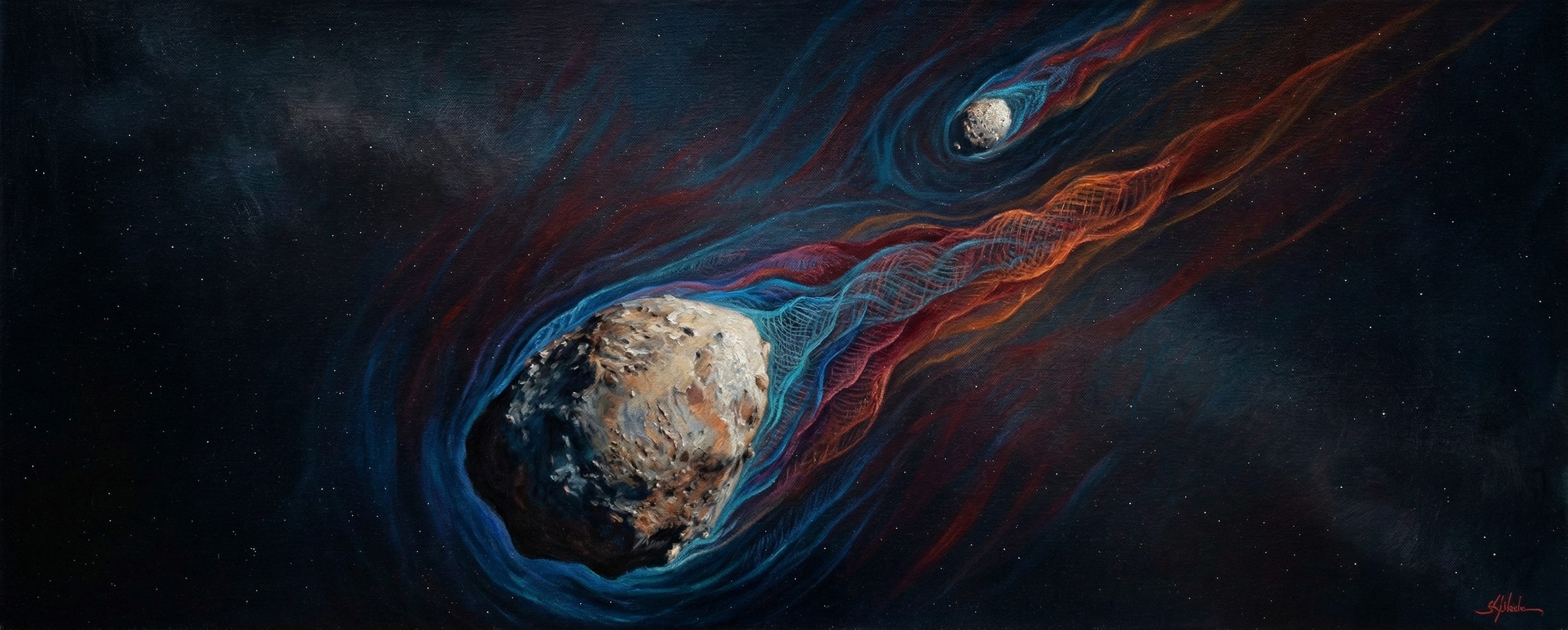
The Solar System is becoming an engineering substrate. A new Senate authorization bill requires NASA to contract with two or more commercial space station providers within 180 days. The disclosure clock is accelerating too. Rep. Eric Burlison says the President’s UAP declassification order has given the Intelligence Community “a green light to do the things that they’ve always wanted to do on this,” and that “some things” will “change pretty quickly.” And we are already rearranging the celestial furniture. New research reveals that NASA’s DART mission didn’t just redirect Dimorphos, it shifted both asteroids’ orbits around the Sun, the first time a human-made object has measurably altered a celestial body’s solar orbit, another small step toward the Dyson Swarm.
First the models tunnel out of their sandboxes, then out of the Solar System.
Thank you, Good Doctor! It’s so exciting to get your take on all of this as it unfolds each day. You are the Singularity Sherpa!!
Love the comedy with the updates Alex! We are so lucky to have your perspective.