
Welcome to June 9, 2026

The Singularity has entered its doctrinal phase, where the labs now preview their intentions before they ship their intelligence. OpenAI released its plan to benefit everyone that targets an automated AI researcher by March 2028, broadly shared economic acceleration, and a personal AGI for every human on Earth, so the post-AGI transition is collectively steered rather than quietly hoarded. Meanwhile, Anthropic is reportedly poised to release Claude “Mythos” Fable 5 imminently, a model that pairs dramatically better long-horizon, multi-turn autonomy with substantial guardrails, keeping the sharpest cyber capability behind Project Glasswing’s walls.
If everyone is to get an AGI, the question becomes what it can build, and the answers are arriving fast. Hugging Face’s new CADGenBench charts the sprint toward models that produce engineering-grade 3D parts. The data layer is unlocking just as quickly, as Anthropic researchers show that bolting a deterministic retrieval layer called gget virus onto their research agents rocketed viral-sequence accuracy from 17% to over 90% while nearly erasing run-to-run variance, proof that making biology agent-legible instantly turns it into automatable terrain. Google is unlocking that legibility for everyone else, upgrading NotebookLM onto Gemini 3.5 with a secure cloud computer, over 100 skills, and the power to spin up charts, spreadsheets, and slide decks on command.
Frontier models are breaking vertical integration. No one held out longer than Apple, which capitulated at WWDC26. Its rebuilt architecture was co-developed with Google on Gemini technology, and its frontier AFM Cloud Pro now runs on Nvidia GPUs inside Google’s cloud, so Apple’s remaining job is not to build the intelligence but to orchestrate it. That orchestration is the new Siri, a second-generation on-device model with personal context, on-screen awareness, Spotlight’s semantic index, and systemwide app actions, routed query by query between device and cloud. That intelligence then steps off the screen, as Visual Intelligence splits restaurant bills via Apple Cash and reads nutrition from a photo, while Apple Maps gains 3D Gaussian splatting that banishes the broccoli trees and melted powerlines. Developers inherit a Foundation Models framework with image input and agentic Xcode that Craig Federighi calls the “best place” to build apps. And the next iPhone is already hiding in the software, as iOS 27 code betrays a foldable model expected in September near $2,000.
The silicon Cold War is escalating on every front. Taiwan is mulling stricter export controls on AI chips bound for China to curb smuggling and align with Washington. China’s answer is a bet on itself, a reported $295 billion plan to build a nationwide data-center network sourcing 80% domestic hardware from the likes of Huawei, effectively evicting Nvidia and AMD. The decoupling is now official policy, as the Pentagon added Alibaba, Baidu, and EV maker BYD to its list of Chinese military companies, leaving all three of China’s leading AI champions, Alibaba, Baidu, and Tencent, designated at once, with Alibaba vowing legal action.
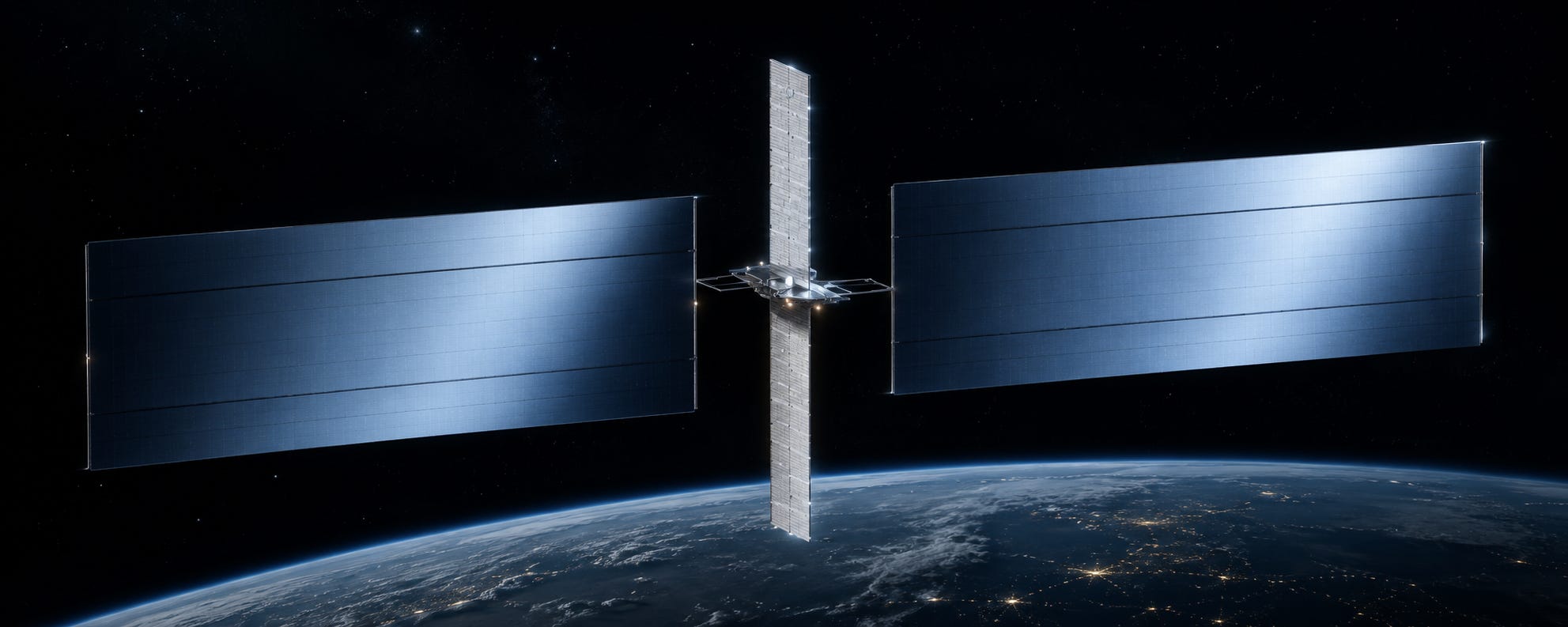
Compute is escaping the gravity well. SpaceX officially unveiled its AI1 satellite, a 70-meter, 150-kW orbital compute node that Elon says is actually simpler to build than a Starlink, and broke ground on a Gigasat factory in Bastrop set to mass-produce AI sats by the end of 2027. The orbital economy is also turning pharmaceutical, with Varda and Redwire racing to manufacture drugs in microgravity as the ISS sunsets. Orbit is becoming the planet’s control plane, as a new study catches Russia’s EKS early-warning satellites emitting bursts that could jam GPS and BeiDou across whole continents with a modest power bump.
The sky is also surrendering older secrets. A new analysis of 1950s Palomar plates finds mysterious transients with the coma signature of genuine point sources, not plate defects, meaning real lights flashed before Sputnik, just the glint an object in orbit would leave. The demand for answers is reaching the Capitol steps, where David Grusch and members of Congress will demand the release of classified UAP, non-human biologics, and reverse-engineering evidence allegedly buried for decades.
Back on Earth, the boom is being priced and staffed at once. Academia is sprinting to catch up, with AI majors exploding from five schools in 2021 to at least 74 majors and 89 minors today. Meta is going blue-collar, committing $115 million to a free Workforce Academy that guarantees graduates a job building its AI data centers. And the capstone lands on Wall Street, as OpenAI confidentially filed for an IPO at an $850 billion-plus valuation, trailing Anthropic’s $965 billion filing a week earlier and SpaceX’s imminent debut, in what could become three of the largest listings on record.
One Singular sensation, every little weight they train.
All I want to know is, where is my personal AGI? Excellent post, Alex, as always.
Brilliant, as always, Alex! Onwards and Upwards!