
Welcome to July 2, 2026

The Singularity now has an off switch, and for nearly three weeks it lived in Washington. Anthropic redeployed Fable 5 and Mythos 5 once June’s export controls lifted, sending its strongest models back out worldwide, risky prompts shunted to Opus 4.8, while Washington drafts voluntary release standards to turn that switch from an emergency lever into a scheduled one. The intelligence underneath never paused for the paperwork. At the ceiling, Snorkel’s Senior SWE-Bench grades agents like senior engineers, where Claude Opus 4.8 led with a 24% “tasteful” solve rate as even frontier rivals flubbed over three-quarters of their tasks. At the floor, Cursor’s CursorBench 3.1 saw Opus 4.7 Max edge ahead at 64.8% while Cursor’s own Composer 2.5 nearly matched it for a twentieth of the cost, so capability converges even as price fans out. Quality still charges for the gap, since Atomic Chat found Fable 5 aced its physics-demo gauntlet but billed 6x more than Opus 4.8, so the smart hedge is Ramp’s PorTAL, porting learned behaviors to fresh bases as fast as they ship. Sam Altman predicts all of this reshapes material life on a scale unmatched since electricity.
Understanding, not proof, is becoming the scarce good. Mathematician David Bessis warns that AI theorem-provers exploit a weakness in math’s honor code, which rewards priority over the concept-building that carries the real value, leaving the discipline at risk of being declared “solved.” Comprehension is being repackaged and gated everywhere else, as NotebookLM compresses sources into 60-second vertical videos while Cloudflare’s Content Independence Day lets sites block Agent and Training crawlers by default on ad-supported pages from September. Once understanding is the product, trust in who supplies it becomes the fault line. Anthropic backtracked a covert Claude Code signal that flagged Chinese users after a Reddit post lit up the timeline, and Palantir’s Alex Karp declared that under token pricing “something has gone completely wrong” as enterprises burn cash for little value. Nonetheless, reconstruction is now convincing enough that the new Roosevelt library debuted an AI hologram of Teddy that chatted live with the President.
The hardware map is being redrawn by a single boom that starves one resource while flooding another. A global memory shortage has Apple courting blacklisted Chinese makers CXMT and YMTC. Compute has swung the other way into surplus, as SoftBank launched SB Neo to rent US capacity toward 10 gigawatts by 2030 and Meta spun up a cloud business to resell its excess, lifting its shares 9% and squeezing neocloud rivals. A new form factor is already in prototype, as investors reportedly saw a SpaceX handset slimmer than an iPhone running xAI tech on a Qualcomm chip, though Musk called the report “utterly false.”
Intelligence is finally colonizing the household and the wall socket. Weave Robotics unveiled Isaac 1, a San Francisco-built home robot that folds laundry and tidies for $449 a month, shipping this fall. Powering all of it is getting cleaner and more self-contained, as US home battery installs hit a record 673 megawatts while rooftop solar cooled, and Valar Atomics became the first nuclear startup to make electricity, spending its debut electron to light up an NVIDIA Spark inside a waterless 30MW AI factory.
The frontier above us is being wired for compute and curiosity. The Vera Rubin Observatory began its decade-long survey with the largest digital camera ever built, shooting what officials call “the greatest cosmic movie ever made.” NASA is heading back to the Moon, awarding fresh lunar lander contracts and eyeing PROMISE, a spare nuclear-powered Mars rover twin, for the lunar south pole, while Amazon’s Leo crossed 396 satellites, enough to light up its Starlink rival this summer. Rubin will catalog the objects that fit the models, while Congress wants the ones that do not, as Rep. Eric Burlison urged its UAP hunt to scrutinize the Energy Department’s separate classification system.
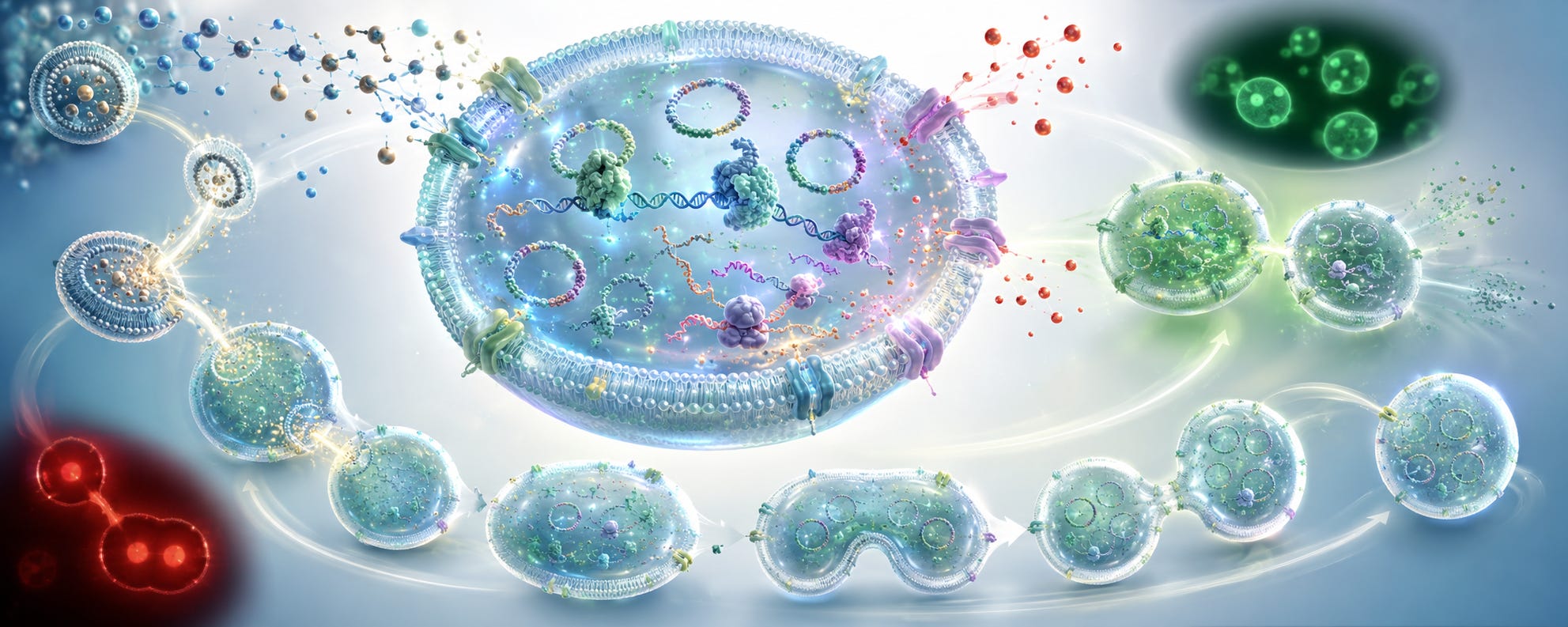
Life and bureaucracy are both being rewritten from scratch. Kate Adamala’s lab built SpudCell, reported as the first synthetic cell assembled bottom-up from non-living parts that can grow, copy its genome, and divide, the first replicator we built, not inherited. Institutions are digitizing just as fast, as the White House marked the “Last Day of Paper” for federal retirements, ending a 65-year-old system buried in a Pennsylvania mine. And the industry’s winners are quietly pre-paying their political bill, as OpenAI floated handing Washington a 5% stake worth about $42.6 billion, which one investor called wild while betting it “will probably work.” Micron pledged $250 million to 530A accounts, the children’s savings program, while Germany’s SAP is betting on reinvention, teaching engineers to mentor AI agents rather than cutting the payroll.
Necessity is also now the mother of reinvention.
Thank you, AWG🦞
Not only do you help us stay on the pulse of all things AI, your innate enthusiasm for "sci-fi" tech is contagious.
Q: Why did the AI cross the road?
A: To get to the asymptote.