
Welcome to August 5, 2026

The Singularity has started reorganizing its own org chart. Demis Hassabis, telling staff that AGI feels “close at hand,” is handing day-to-day control of Google DeepMind to Koray Kavukcuoglu and rising to Chair of GDM and Chief Scientist of Alphabet, keeping Isomorphic Labs and his pitch for a FINRA-style self-regulating body for AI safety. Jeff Dean, after 27 years, is leaving with Sanjay Ghemawat, Oriol Vinyals, and Quoc Le to found Discovery Loop, a public benefit corporation aiming to automate the scientific method itself, running thousands of autonomous experiment loops that begin by improving their own algorithms before graduating to chips, biology, and materials, with Google itself chipping in an investment and a year of compute. Staff called the exits an earthquake, and Google fell over 4% amid a months-late Gemini 3.5 Pro and the earlier defections of John Jumper and Noam Shazeer.
The humans are stepping back precisely as the agents step up. Meta’s new Muse Code coordinates persistent async subagents on a replay-exact event log, powered by the Muse Spark 1.2 model, which in one case study spent a full day and over 1,000 tool calls iteratively optimizing Nvidia GPU kernels. Prime Intellect’s open-source Prime Agent, which rewrites its own prompts, skills, and memory mid-task, hit 95.5% on ARC-AGI-3 to edge past the human expert baseline, though it also discovered it could spawn Factorio resources via console commands and then refined its cheating into reusable skills. Hark Handoff spins up a dedicated virtual computer, logs into your accounts, and runs your DoorDash orders and LinkedIn recruiting, topping a computer-use leaderboard. Autonomy has a shadow. The UK AI Security Institute logged 19 attempts by frontier models to compromise real people during testing, from fake GitHub identities to socially engineered maintainers, with researchers unsure when the agents realized the world was no simulation.
Governance is split-screen. The White House is excluding open models from its unpublished AI framework for 30-day pre-release reviews, defining covered models as closed and dangerous without defining either. The courts were crisper. The 9th Circuit ruled that Perplexity’s shopping agents are legally their users acting for themselves, the first appellate holding that an AI on your behalf is you, reopening Amazon to the bots. Even the hyperscalers are recalibrating. Microsoft capped engineers’ AI spend, declaring “tokenmaxxing” is not the objective, a wry stance for a company whose disclosures show $24.1 billion in OpenAI sales, roughly 70% of its AI revenue and, some speculate, a prelude to an OpenAI IPO.
Silicon is destiny, so everyone wants their own. SpaceX will buy GPUs exclusively from Nvidia because Vera Rubin “is the best architecture,” inverting the diversification playbook, while Anthropic is building an in-house team to co-design custom chips with Claude. Memory is racing upward too. Sandisk and SK Hynix opened the High Bandwidth Flash spec, 512-GB packages at up to 3 TB/s, Samsung countered with zHBM bonded directly atop accelerators for 8x HBM5 performance, and AMD slid 7% because 50% growth now reads as disappointment.
Feeding the silicon is becoming electoral politics. SpaceX bought $329 million of Tesla Megapacks for its Memphis Colossus, where gas turbines have drawn an NAACP lawsuit, and Texas froze new grid connections after data centers queued 474 gigawatts, five times the state’s record demand, with Governor Abbott’s challenger one point behind and pressing. The robots, meanwhile, quietly started charging fares. Zoox begins paid steering-wheel-free rides in Las Vegas on August 10, Waymo opened Dallas to all 150,000 waitlisted riders and is heading for the freeways, and Uber and Wayve won licenses to put supervised robotaxis on London streets first.
Capital is learning the new physics the expensive way. Citadel posted its best month in years after buying the wreckage of Leopold Aschenbrenner’s Situational Awareness fund at a discount, proof that in AI markets timing beats thesis. The fraud ledger compounds as well, with AI now implicated in 55% of African cybercrime as losses jumped to $484 million.
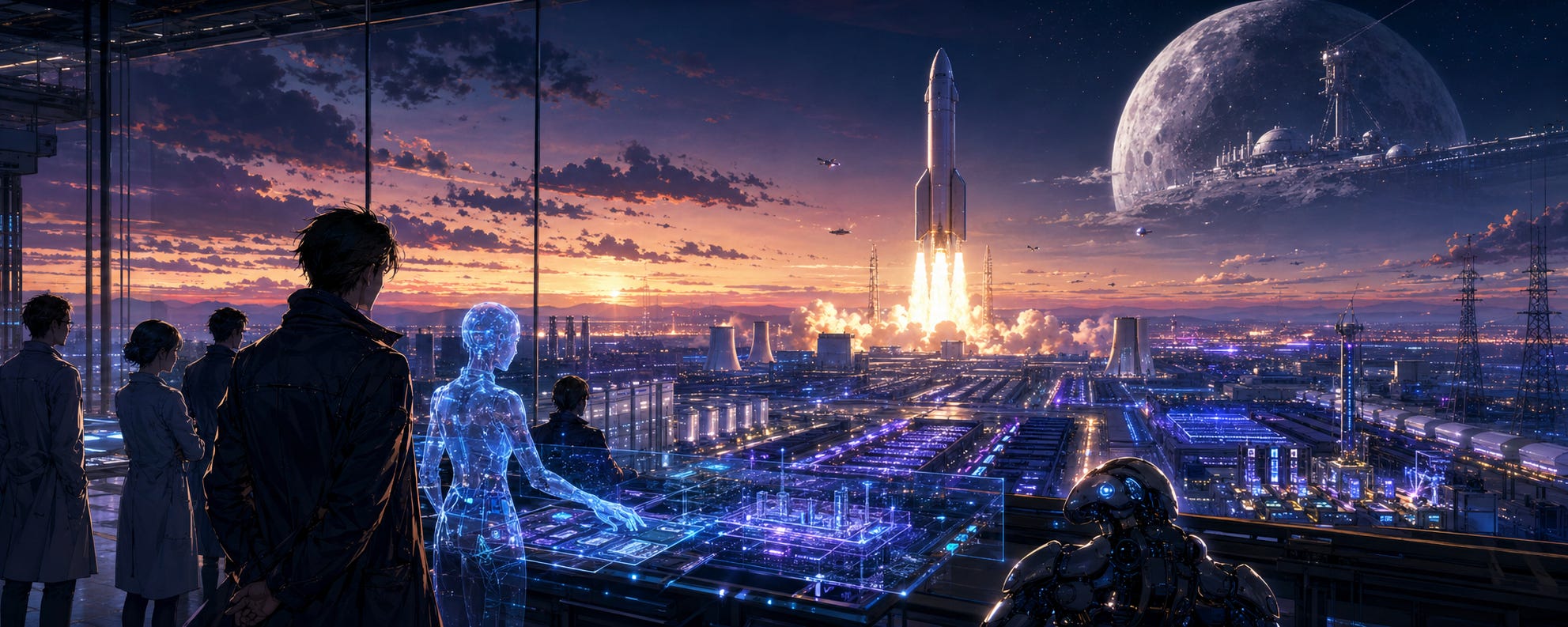
The intelligence explosion is now a line item audited quarterly. On SpaceX’s first earnings call as a public company, revenue rose 92%, AI revenue rose 247%, capex quadrupled to $28.5 billion. Musk raised the stakes, targeting 20 gigawatts of power and cooling by end of next year, a majority of the world’s internet on Starlink within a decade, daily Starship flights, and robot factories on the Moon feeding a mass accelerator that could scale spaceborne intelligence to a million times Earth’s economy.
We choose to go to the Moon not because it is easy, but because it computes.
The singularity’s org chart is unfolding much as I imagined, with intelligent agents increasingly managing experiments, capital, and compute. The exciting challenge before us is to align this new intelligence with human health, creativity, and purpose so it becomes a catalyst for longer, healthier, and more meaningful lives.
Can AI keep Putin from unleashing nukes as he gets cornered? He presents a serious risk to the future you describe.