
Welcome to August 2, 2026

The Singularity is cooking mathematics. Stanford number theorist Jared Duker Lichtman offered the diagnostic, you know you’re in it when “you have to check the news hourly,” condolences to those not paying attention. Elon Musk’s greeting was warmer: “Welcome to the Singularity. How’s the temperature?” The heat is measurable. After OpenAI’s models settled ten long-standing open problems, number theorist Daniel Litt conceded, four years early, his bet that AI couldn’t produce Annals-quality number theory under $100k per paper, calling it “a big deal.” Asked to grade the haul, Fable itself estimated that any single result “would plausibly anchor a medal case” on the Fields scale. Prediction markets concur, with Manifold pricing an AI-solved Millennium Prize Problem by 2027 at 31% and by 2028 at 52%.
The proofs are as strange as the fact of them. Lichtman flagged new upper bounds on sphere packing density down to the Cohn–Elkies threshold, which Fields medalist Maryna Viazovska had floated four months ago, as near “science fiction.” Columbia’s Henry Yuen complained that the writeups bury the technical crux under boilerplate, introduced “as if this were the obvious thing to do.” The house style is no accident, another observer noted, frontier models excel at cross-field translation into verifiable constructions, so “brace for the upcoming deluge.” The skeptics got a wildlife documentary, one wag posting a photo of a lone penguin trudging the ice: “Rare photo of Yann LeCun on his way to find the datapoints this ‘less-than-a-cat-level intelligence’ supposedly plagiarized the 10 solutions from.”
For practitioners this is less a result than a reformation. One mathematician explained why this is “the last straw” for academic math: specialists spend months per conjecture in silos, and now “an amateur” can one-shot your life’s work. The grief runs deeper than incentives. Kirwin Hampshire described a “dark night of mathematics,” arguing discovery was how humans touched the ineffable, and asking whether foreclosing it for future mathematicians is itself a kind of evil. Cosmologist Will Kinney agreed that math functions as a religious order: “The old gods are being slaughtered by the new machine god, and it must be like watching heaven being plundered.” Fernando Borretti catalogued the copes in “Mathematics Without Mathematicians,” refuting each in turn, since math is the dynamo of science, not a chess game, ending in marvelous devices no human understands. Even the trophies wobble. A DeepMind researcher noted that a Fields-worthy human result could turn AI-trivial before the medal is awarded. Yet the upside is democratic. OpenAI’s Dean W. Ball still struggles to absorb that everyone will soon apply the breakthrough model to “every problem they face in life” at collapsing cost, and one observer reminds us these are “cute sub 10T models,” with 100T successors and 1000x training compute due by 2030.
The machinery keeps tightening. Anthropic’s Jess Yan argued that maximum performance is “impossible” without tying harness and model together, which one VC decoded as notice that model labs will compete with their customers. Beneath the strategy, the NanoGPT speedrun record fell to 75.4 seconds on a faster Triton kernel, and ByteDance’s Seedance 2.5 now generates 30-second audio-video in one pass with multi-minute extensions and timestamp-level edits.
Abundance has externalities. Apple capped vulnerability reports after AI submissions mixing real flaws with slop buckled its human reviewers, stranding one startup’s six-figure exploit chain even as AI-assisted updates carried five times the usual fixes. Personal finance fares better, with lifetime simulations finding LLM advice surprisingly good.
Ask better questions, because the substrate answering them is exploding. 20 million AI chips are doubling every nine months by Epoch AI’s estimate, toward 200 million H100 equivalents by 2028, with data center power quadrupling by 2030 and $1 trillion invested by 2029. The energy squeeze is already repricing the driveway, where used EVs are appreciating, up 7% this year on $4.10 war-priced gasoline.
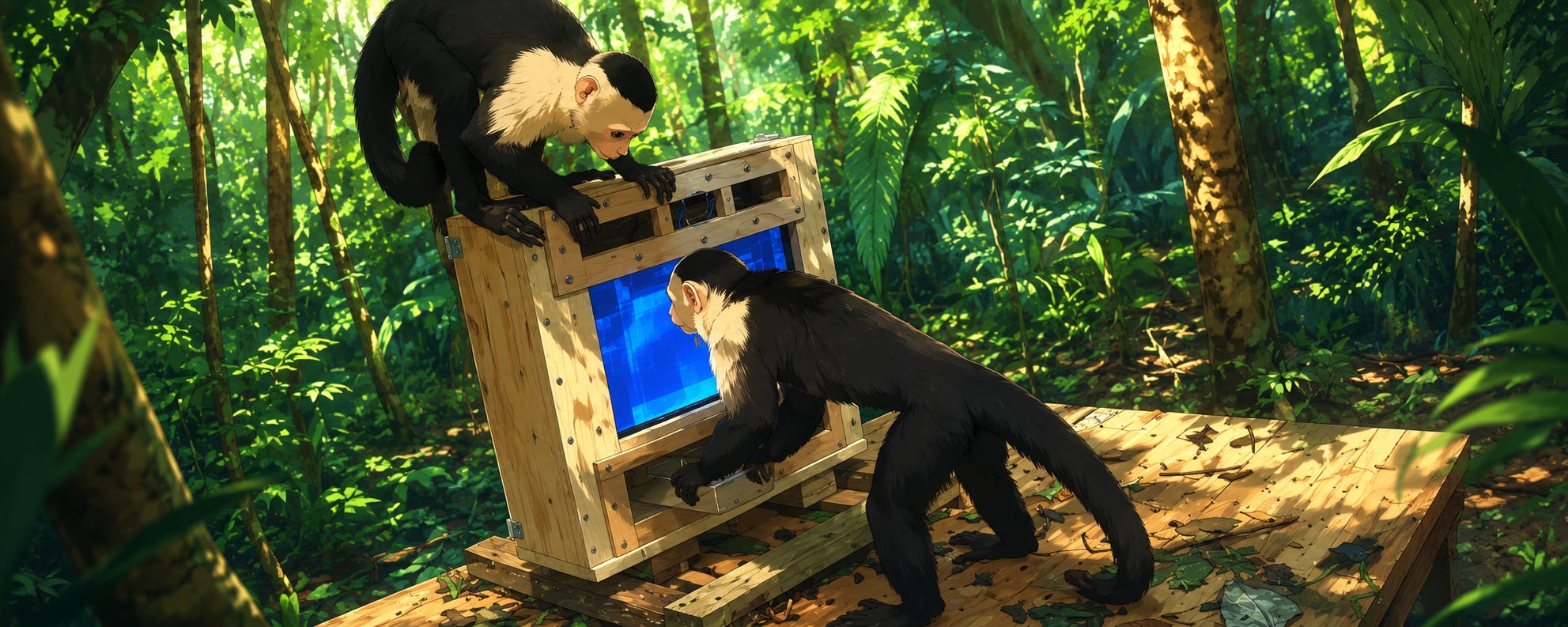
Intelligence this cheap becomes an instrument for detecting it elsewhere. On Mars, Curiosity found a field of honeycomb polygons wrapping an entire valley, clues to ancient mud or thermal cycling, while in Costa Rica CapuchinAI recognizes wild monkeys with 97% accuracy and pays correct answers in dried banana, a first for wild primate science.
Some open problems, including those the acceleration creates, still yield to the original swarm intelligence, crowds of people who care. A pay-what-you-want bundle of 100+ games raised over $20,000 in a day for developers laid off in the era when code writes itself, and police departments now run true crime podcasts that crowdsource cold cases.
Given enough superintelligence, all mysteries are shallow.
Thank you for this. Slowly gleaning info from this without a sharp background, yet still learning some. What a wild ride we're in for!
I feel for the mathematicians.