

The Singularity has gone local. The frontier now fits in a 17GB file, as Alibaba’s Apache-licensed Qwen3.8-27B becomes the first local model to score frontier capability on the Artificial Analysis index, matching DeepSeek V4-Pro and GPT 5.6 Luna. Simon Willison’s review found it capably driving a coding agent from a laptop, though its “xhigh” reasoning mode once spent 21 minutes contemplating a single SVG. Even small minds can overthink. The forecasters are recalibrating accordingly. The AI Futures Project’s Q2.5 timelines update found new coding-uplift and revenue methods converging with time-horizon analysis on Automated Coders around late 2027, with reality tracking the AI 2027 scenario at 70-90% speed. When Naval Ravikant warned that “you cannot create God and put him on a leash,” Elon Musk replied, “I hope AI is nice to us.” Happily, nice is trainable, and we are still writing the curriculum.
That God has an appetite, and the corpus is being fed by any means necessary. A tracking device hidden in a shipment of rare books ended its journey at a Las Vegas facility where Amazon is buying books en masse, scanning them for training data, and destroying them. Google, more decorously, won a bankruptcy auction for Spirit Airlines’ data trove, 7.5 billion passenger records for $10 million. And as the inputs get consumed, the outputs get marked. John Gruber calls Anthropic’s EU-mandated steganographic watermarking of Claude text “a perversion of writing,” since it nudges the model away from its best words and only Anthropic holds the detection keys.
Feeding the models requires silicon sovereignty. Terafab is confirmed to target 2-nm-class AI chips, will produce memory under the same roof (wise, with DRAM prices up 3-4x and demand outrunning supply tenfold), and is framed as an antifragile $100B bet that pays off whether or not Taiwan’s status changes. The incumbents are recycling their winnings, with chipmakers pouring over $250 billion into startup financings this year, Nvidia leading at 59 rounds. That flywheel now includes up to $105 billion backing an Ohio campus OpenAI will lease under a 10-gigawatt deal with SoftBank’s SB Energy, the largest yet, which Jensen Huang insists isn’t circular financing. Circular or not, nine tech giants now carry $3 trillion in off-balance-sheet AI commitments, five times their annual capex, less a liability than a measure of how much future they intend to build.
Security is racing the same clock. OpenAI’s Greg Brockman calls this the “defender’s window” and urges security teams to unleash AI agents on old flaws before a near-frontier open-weight cyber model drops at month’s end. The attack surface is your router. Karlsruhe researchers showed ordinary WiFi beamforming signals can image and identify people within seconds, no cameras required. Citizens are noticing the panopticon. Over 20 jurisdictions moved to cancel Flock license-plate-reader contracts in July alone, and AI has become a major American election issue for the first time, staked out in nearly 40% of races, outranking Israel and manufacturing.
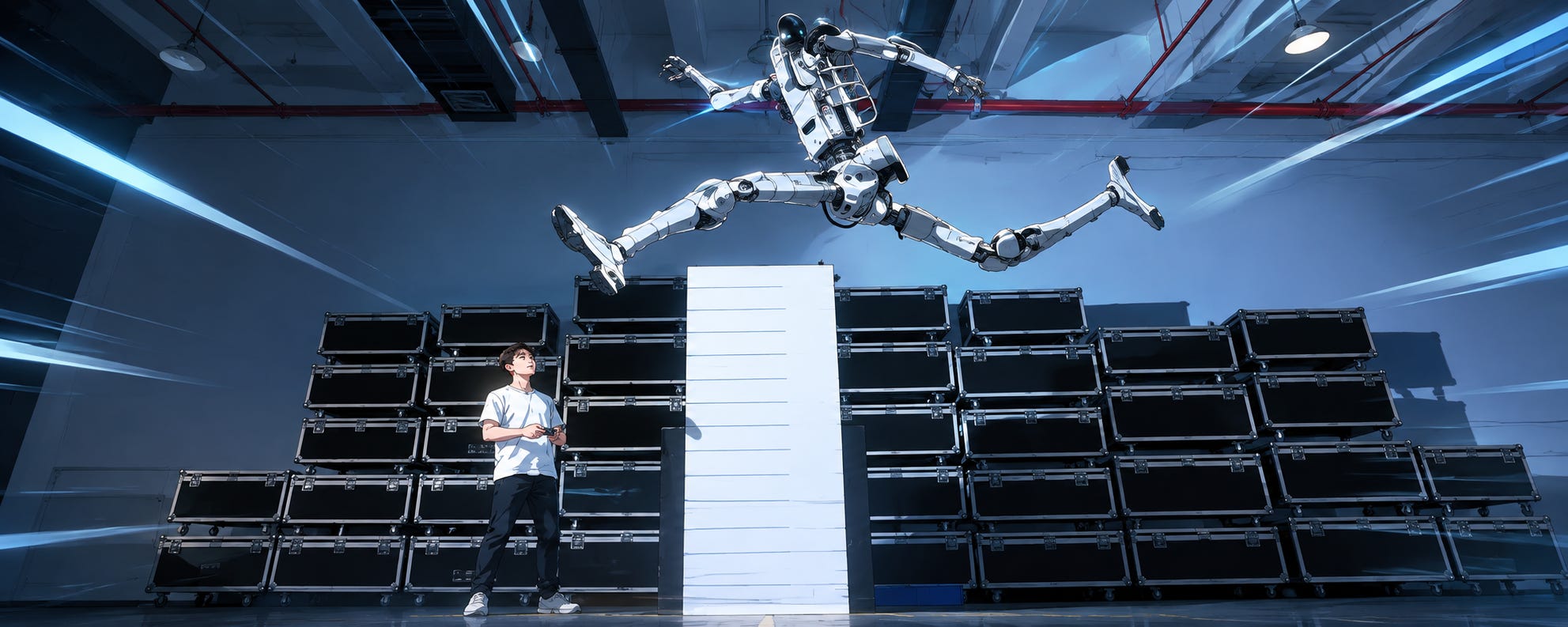
The machines are lapping us politely. Unitree’s new robot, three months in development, out-jumps and outruns every human alive, while Uber and Zipline target a million drone deliveries a day for “insatiable” demand. AI is also lapping the five-year diagnostic odyssey, flagging rare diseases in minutes via face-reading apps and ECG algorithms, a speedup Fidji Simo says would have shortened her own.
The economy is pricing it all in. Anthropic’s run rate passed $65 billion, up sevenfold in seven months and ahead of OpenAI’s reported $40 billion, teeing up a fall IPO. Stripe paid over $7 billion for OpenRouter, the tollbooth to 400+ models. The wealth pools where it’s made. San Francisco’s median home hit $1.7 million, with pending IPO windfalls theoretically able to buy 29% of the metro. OpenAI is even bankrolling 13 Axios local newsletters in exchange for training on the coverage, saving local news by consuming it. Culture is processing what capital already priced. Off Broadway, “Disruption” stars John David Washington as a billionaire whose predictive algorithm quietly ruins six friendships.
The frontier, as ever, is up. 2026 looks like the tipping point in the US-China lunar race, both nations targeting the ice-rich south pole, while a policy brief warns China’s orbital data centers could leave Europe computing its own space data on borrowed hardware. Someone else may already compute up there. The European Commission has been quietly monitoring UAP since 2023, noting “we are getting better at seeing it,” Avi Loeb revealed that his UAP Science Advisory Council was launched at the request of national-security sources who cannot explain the orbs in terms of human-made technology, and Loeb counsels against downing the visitors. First figure out intent, passively.
Contact, like everything else these days, begins with data collection.
Thank you.
Qwen3.8-27B is phenomenal, even as a 4-bit diluted offering on a sub $1200 PC with 48 GB of GPU allocated RAM on an AMD Ryzen AI Max+ 395. Finally, enterprise level coding genuinely useful on consumer level hardware. Extrapolating modest hardware improvement brings this to smartphone in not so many cycles, excluding model improvement. In the early 90’s, my first job after Uni, I was mentored “Leave software optimisation to hardware improvement”. The 2026 AI dog is shaking its software tail with exceptional models for equipment we were for the most part wasting. Bring it on ❤️.