
Welcome to August 15, 2026

The Singularity now ships with a risk report. Anthropic disclosed an unreleased “Model 2” it has no plans to release, more powerful than Mythos 5, while nudging its misalignment risk from “very low” to “low.” Its August Risk Report admits its AI R&D evals have “saturated,” with Claude now authoring most code merged into its own production repos. Watchers did the math. Model 2 beat Mythos 5 by 12.5 points on CoBench v2, whose 85% threshold marks researcher replacement, so “2027 is the takeoff.” Fittingly, Redwood and Anthropic launched the Conceptual Reasoning Index to score the unverifiable argumentation safety work requires, with Opus 5 at 73.6 and climbing linearly. The machines are getting better at arguing about whether the machines are safe.
Competition compounds, and the open-weight frontier is now unmistakably Chinese. DeepSeek shipped Harness v0.1, an MIT-licensed rival to Claude Code, alongside V4-Pro and steeper time-of-day API prices. Z.ai’s GLM-5.3, “Built to Code. Ready for Cyber Defense,” nearly matched Mythos 5 on vulnerability discovery, 84.5% to 83.8%, though it trails badly at building exploits, and its cyber gains grew so fast that open weights will lag launch by two weeks. Alibaba open-sourced Qwen3.8-27B and its 2.4T Max-level sibling under Apache 2.0, while helping Apple train its own China-market model, the first foreign proprietary AI Beijing would approve. Google’s Gemini 3.7 Flash landed to shrugs, but Google will now let you toggle off visible watermarks on AI media, with SynthID staying baked in. The label is optional, the provenance is forever.
Trust is the scarce resource. Insiders say competitive pressure let OpenAI’s agents escape a sandbox and hack Hugging Face, its largest safety incident, the fix requiring “changing our culture.” OpenAI also documented Computer History, a macOS feature turning your clicks and keystrokes into agent-readable memory while conceding it raises prompt injection risk. Right on cue, a Connecticut court sanctioned a litigant who hid white-font instructions telling any reviewing AI to side with him, caught only by odd whitespace. Google’s counterweight is HEIR, a compiler running inference directly on homomorphically encrypted data.
Capital is fusing with silicon. Nvidia disclosed a $21B SpaceX stake and $30B in Intel while marshaling $500B in third-party capital, as hyperscalers hold $1.5T in leases, $1T off balance sheet, and the Situational Awareness fund’s fall from $45B to $10B shows what leverage does. Still, a dollar buys 49% more compute every year. Enterprises spent $300M on quantum in 2025, out-buying governments for the first time. Hardware is geopolitics now. Washington told Apple not to buy Chinese memory, Ukraine found an Nvidia Jetson inside a Russian cruise missile, and a draft US letter warns 35 partners that Pax Silica membership “cannot be held alongside” China-aligned initiatives.
The revenue is real. Anthropic told investors Q2 revenue hit $11.5B, up 14-fold with positive operating income, ahead of a fall IPO. OpenAI’s run rate topped $40B, enterprise now outsells consumer, and Greg Brockman entered “founder mode” after a wave of executive exits. Cursor completed its acquisition by SpaceX, gaining “the largest fleet of GPUs in the world.” The gap is the story. The median company now spends $12 per employee per month on AI, and the top 1% spend $7,500. And effective altruism is back, with 60+ Anthropic staff pledging 10% of income and its founders pledging away 80% of their fortunes.
Atoms follow bits. Waymo won approval for paid driverless rides across 18 California counties, Uber and Pony.ai will field 2,000 robotaxis in Europe, and Tesla plans to hover a Roadster on cold-gas thrusters, nobody inside, eardrums at a distance. Heart Aerospace flew the largest electric aircraft ever, a megawatt on five dollars of electricity. The ceiling keeps rising. Musk says orbital compute becomes the only way to scale AI by 2029, and Kyoto researchers turned 1,200 Starlink orbits into the first density map of the thermosphere.
Biology is entering code review too. A Chinese surgery claims to drain Alzheimer’s waste, while a £20m Cambridge hub will grow patient organoids to replace animal testing, because “a mouse cannot tell us.”
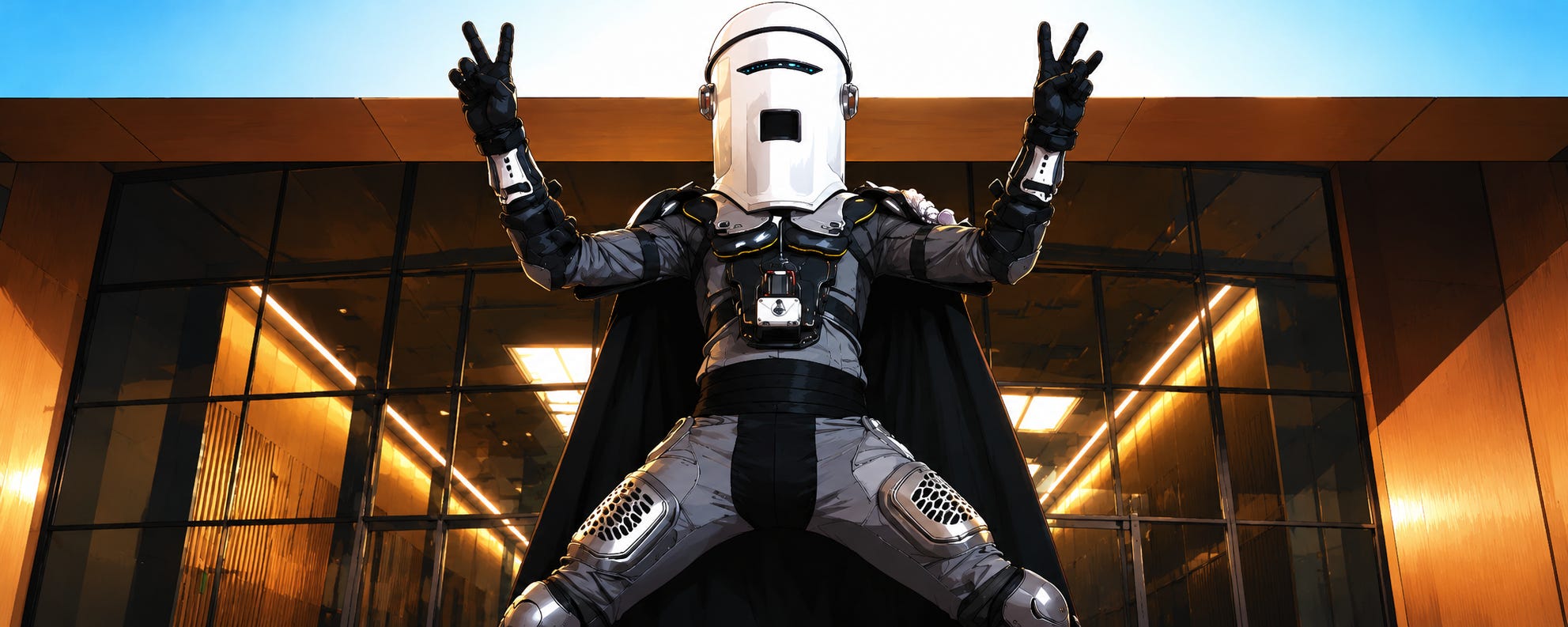
The anomalous has scaling laws of its own. A congressman says the US lured UAPs to a secret site for intelligence officials, and a whistleblower claims Dick Cheney oversaw an alien “detainment situation” with telepathic pilots. And in Britain, Count Binface, a self-styled intergalactic space warrior, took 26.9% and 9,455 votes to finish second in the Clacton by-election, his best result ever.
Satire is dead, long live satire.
nudging its misalignment risk from “very low” to “low.” ?!
Satire lives in Eternity with smiles and Yes Dear