
The First Consumer-Scale Interspecies Foundation Model

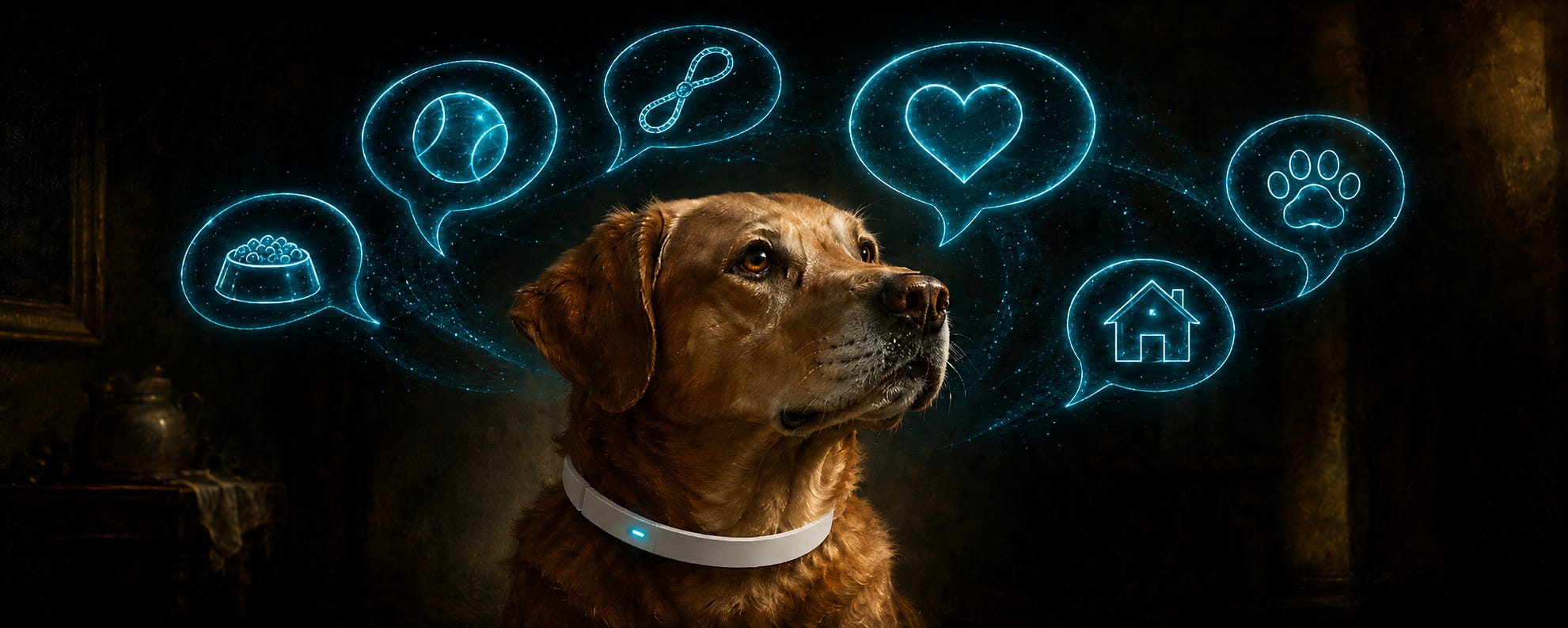
The Singularity has been fluent in exactly one species, the only one that ever wrote its mind down, until now.
Everything AI has ever learned came with a record already written. Text, code, protein, images: humans had documented each domain, and the machine only had to read. AI progressed in the order things were written down. Non-human animal cognition is the first frontier where the record does not exist, because no other species ever wrote one down. Worse, meaning lives not in the signal but in what reliably happens around it. Synthetic data cannot help, because they only interpolate distributions a model has already seen, and no model has ever seen what another species means. The non-human data have to be measured into existence.
Today, Sarama, an interspecies foundation model lab founded by Praful Mathur that I helped form and advise, backed by 021T Capital, is announcing the world’s first consumer-scale interspecies foundation model, beginning with a dog collar.
The field has prior art. Earth Species Project’s NatureLM-audio and Google’s DolphinGemma are foundation models for animal sound; Project CETI applies AI to sperm whale codas. All learn from researcher-collected archives. Sarama’s bet is the opposite: data generated and self-labeled by an instrument in the home.
Dogs had to be first. They are the only non-human mind that co-evolved to be legible to us, shares our naturally labeled home, and exists at consumer scale. And this is not a novelty bark translator. A universal bark dictionary fails for the same reason a universal human dictionary would: meaning is individual. Sarama builds a separate model of each dog, trained on that dog’s own life.
That model reaches the home as a two-mode app. A third-person AR mode overlays a dog’s attempted communications onto the animal via your phone. A first-person collar mode streams the dog’s-eye view, with a newsfeed of what it is trying to say and needs.
See it in action:
Mathur came to dogs the long way. A three-time consumer-supply-chain founder, he built Sarama to be vertically integrated, from app to model to hardware. His chief scientist, Peter Bermant, is a bioacoustics researcher whose work on sperm whale codas was early proof-of-concept for Project CETI. The team spent years decoding whales and dolphins, and yet could not understand their own dogs. They needed a new instrument.
The collar is a custom pod with a camera, a microphone, and motion sensors, with physiological sensing rolling out. It transmits feature vectors, not raw audio or video, so collection stays private. The sensors label themselves: when the camera frames the food bowl, the motion channel logs the lunge and the microphone the bark, three readings labeling one another, no annotator in the loop. That record has no substitute, and compounds with every collar shipped. Already the largest of its kind, it heads toward one million annotated bark sequences by 2026.
This matters most where it hurts. Dogs mask pain by instinct, and illness goes unseen for weeks. A model watching continuously catches early what a dog has evolved to hide.
It works. The collar already reads a vocabulary of core needs and identifies dogs by voice, at roughly 93% accuracy on emotion and intent, surpassing academic benchmarks.
Consider the mind on the other end of the collar. It is the one intelligence that has already solved alignment with us, co-evolved over tens of thousands of years to read human emotion and intent more closely than any animal, a predator that became a member of the household. The law is arriving at the same place: New York weighs a companion animal’s best interest in divorce, Pennsylvania is following, and the frame is shifting from property to personhood. What it has lacked is an instrument to listen with. Dogs are first, not last.
From there it compounds. The instrument that reads a dog reads a horse’s lameness, a herd’s distress, a wildlife population from a drone. The real inheritance is the method: a protocol for modeling a mind that cannot say what it wants. The minds we will most need to read this century will not all be carbon. We are learning to understand the intelligence that evolved beside us just in time to face the kind we are building ourselves.
As Peter Diamandis and I argued in Solve Everything, the Intelligence Revolution turns every scarce domain it touches into an abundant one. The scarcest has been understanding across the line that divides us from every other mind. We have slept beside this animal since long before we invented writing. The Singularity is learning its second language.
Those interested in the alpha can request access at Sarama.ai.
(Disclosure: I have a financial interest in Sarama. This essay is informational only, not investment or veterinary advice. Performance figures are company-reported, and forward-looking statements are subject to risks and uncertainties.)
Expanding AI consciousness through interspecies communication is fantastic! People love dogs, and now we can learn to actually hear them.
Excited to see the AOCs and Sanders of the world argue against this one. Data centers will get no better advocates than man’s best friends