
The First American Professional Robotics Sports League

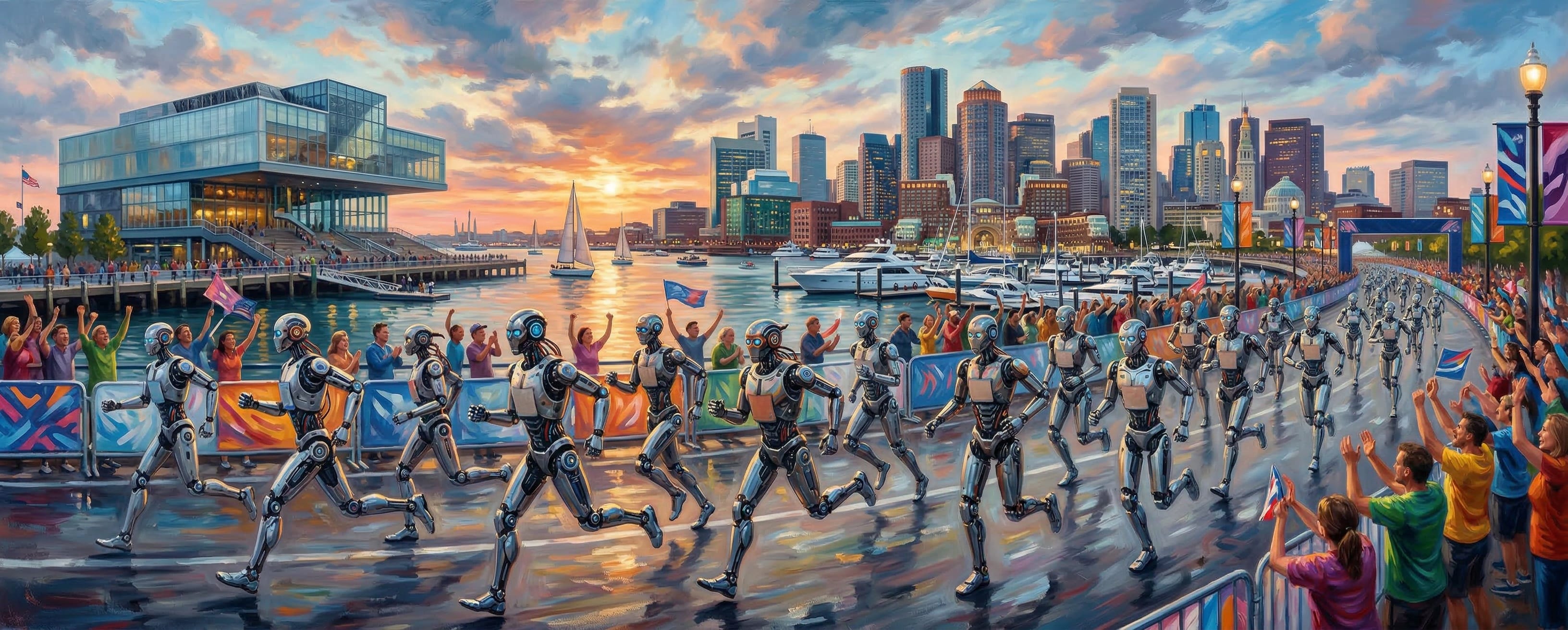
The Singularity just got a stadium.
Last August, 500 robots from 16 countries competed in track and field, soccer, and kickboxing at a former Olympic venue in Beijing. The Chinese government staged it as a strategic national showcase—the World Humanoid Robot Games—and months earlier had hosted the world’s first humanoid robot half-marathon. These weren’t just spectacles. They functioned as public testbeds that accelerated commercialization. The half-marathon runner-up’s manufacturer reportedly received over 2,000 commercial orders in the months that followed. Beijing is using sports events to compress the path from prototype to product, an industrial strategy disguised as entertainment.
The United States has nothing comparable. We have combat robotics (BattleBots, NHRL), educational competitions (FIRST), academic research tournaments (RoboCup), and drone racing (Drone Racing League). What we don’t have is a professional sports league for humanoid and quadruped robots competing for a mass audience. One of the densest robotics talent corridors in America, home to Boston Dynamics, MIT, Harvard, and hundreds of startups, has never had a public-facing showcase for its own technology. We build the most advanced robots on Earth and then hide them at trade shows.
On marathon weekend in Boston, humanoid robots will sprint a 50-meter dash on a spectator-lined course in Boston’s Seaport District, in front of thousands of people. This is the Professional Robotics League (ProRL) Combine, the first professional robotics sports event in American history.
I helped found ProRL because the country that turns robotics into a spectator sport will lead the physical AI economy. This is in keeping with the thesis of Solve Everything, which I co-authored with Peter Diamandis, applied to physical AI: you can’t solve what you can’t benchmark, and a professional robotics league is the best benchmarking infrastructure we can build.
A YouGov survey found that one in three US sports fans already have interest in watching a league of robot athletes, with even stronger demand among younger fans. What’s missing is infrastructure. Rules, teams, seasons, standings. NASCAR did it for automotive engineering. A professional robotics league does the same for the workforce the US is trying to build. ProRL, backed by 021T Capital, is a Public Benefit Corporation. Its mission is to usher in the age of robotics through sports and entertainment, building public acceptance, and accelerating adoption for the broader robotics industry.
The Combine is the founding event. Leading manufacturers, research institutions, and top universities will bring humanoid and quadruped platforms to compete in speed races, obstacle courses, and precision challenges, surrounded by an Innovation Festival with partner activations, engineering demos, and VIP hospitality. From there, the league grows. Expansion events later in 2026. A full 10–12 event season across multiple markets in 2027 with standings and team rivalries. And the competition categories expand to include commercially valuable tasks, the kind of dexterous, task-oriented performance that maps to warehouses, hospitals, and homes. Speed gets people into the stadium. Manipulation and precision challenges show them which robots can actually do useful work.
David Grilk, ProRL’s founder, has spent fifteen years producing nationally recognized races and large-scale live events. Tom Grilk, board member, is the former President and CEO of the Boston Athletic Association who led the Boston Marathon for over a decade and helped build the Abbott World Marathon Majors.
A founding moment only happens once. The manufacturers and institutions that show up in Boston will be the founding teams of American professional robotics sports.
Interested teams, sponsors, and partners can reach out to David Grilk at dgrilk@pro-rl.com. Register for the event here.
The race for robotics leadership is global. It starts on the Boston waterfront.
(Disclosure: I have a financial interest in ProRL.)
Thumbs up! Try to do your best to promote "Gracious Professionalism" as done with FIRST.
...and of course, get some good video!!!
What this really exposes is how normalization is being engineered.
Turning robots into something people watch is how they move from experimental to everyday.