
A Conversation with Cathie Wood

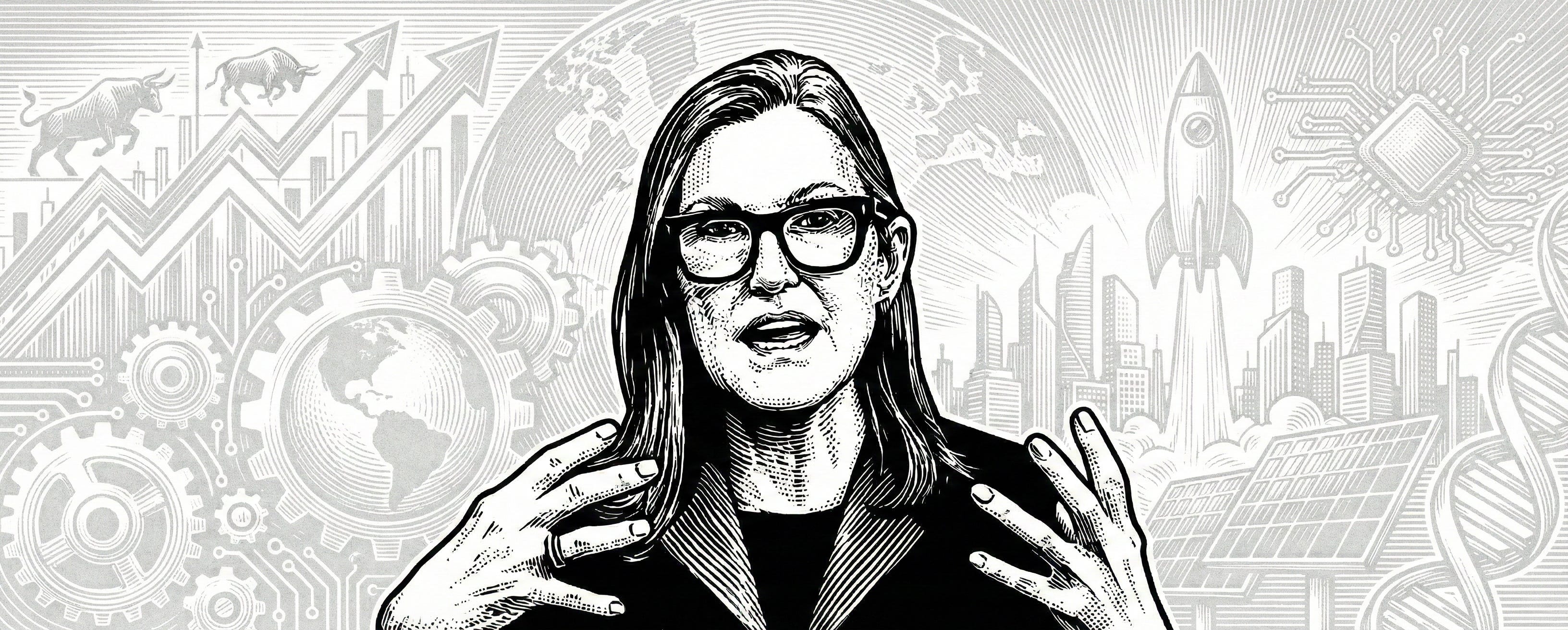
Cathie Wood is the founder, CEO, and CIO of ARK Invest, which manages several actively managed exchange-traded funds based on disruptive innovation, with reported assets of over $20 billion in June 2025. Below are excerpts from our recent conversation, recorded on January 27, 2026, which have been lightly edited for clarity.
On Dyson Swarms
AWG: Cathie, if you extrapolate out naively, as I’ve pointed out in the past, we get to a Dyson Swarm-type scenario where at some point we need enough atoms to build our orbital data centers—just extrapolating naively—that we start wanting to disassemble the moon and other solar system bodies, planets, asteroid belt. Do you foresee—I know you’re very public about 5-year forecasts—but if I were to beseech you to extrapolate a little bit further, maybe call it 50 years out, what is your position on the Dyson Swarm? Do we get a Dyson Swarm? Do we get 10 different competing Dyson Swarms? Do we get no Dyson Swarm?
CW: Well, I’m probably not expert enough to answer that question, but we have taken the SpaceX model much further than five years. And we have incorporated getting… Optimus and Tesla and [The Boring Company] to Mars. And we think that’s very doable. Our space analysts, I’d really want them to dwell on this question. I’d like to dwell on it with them. And I will do exactly that.
On GDP versus Real Wealth Growth
AWG: I think going back though, Cathie, I think you raised a really interesting point that I haven’t heard, to my knowledge, anyone else articulate. Which is, so many people—including folks on this pod—are hand-wringing about GDP and, “Oh, won’t hyper-deflation somehow reveal the intrinsic misalignment between GDP growth and real wealth growth?” But you’ve, I think, put your finger on a point I’ve never heard anyone else articulate, which is that as humanity delegates more and more services to agents, that delegation looks like commerce from a GDP perspective. That by basically carving up humanity’s individual human roles and productive services and subdividing them, all of the interactions between those subdivisions—many of which are going to be agents—are accretive to GDP and look like commerce. So if anything, you’re painting a story for the exact opposite of how GDP statistics can explode in real terms while real wealth perhaps remains constant. So I guess my question for you is: if you could wave a magic wand and define Cathie Wood’s perfect definition, not of GDP growth, but of real wealth growth for humanity, how would you define it?
CW: Well, wealth growth is very much tied to productivity growth. And I’m talking about real wealth growth; I’m not talking about real estate and price-driven... I’m talking more about technologically enabled productivity gains. You know we got a taste of it, just a taste, from the 80s and 90s. It was the pre-Internet age, starting with a PC, then pre-Internet age and pre-mobile age. But back then, which was a magnificent time for the financial markets, wealth creation was stupendous as software for the first time unlocked [productivity]. We went through a frustrating period in the 80s -- I was there -- where technology, it almost seemed as though it was hurting productivity. There were some people out there saying that, and then of course Microsoft came along and -- boom -- and then we had the Internet. Boom. So that was foreshadowing, just foreshadowing, what we’re going to experience here. So there was... if you look at growth, growth accelerated. Not a lot but it accelerated. Certainly from the horrible 70s growth rates. Productivity was, I think, zero or negative for a good part of the 70s into the early 80s and then we saw productivity picking up and the financial markets boomed. And inflation came down. Back then, and the reason I’ve thought about it so much, is very early in my career we had taken a position that inflation was going to come down. Most people thought that couldn’t happen without a depression. It happened for the opposite reason. It happened because of productivity growth associated with these technologies, [and] a sensible monetary policy as well, I will say. Productivity growth lifted unit growth and the history. This is unlike what you would learn from Keynesian economics that’s associated with Harvard primarily, which says growth is inflationary. Growth is not inflationary. Growth is disinflationary and in this world we’re going into it is deflationary. Deflation in the good sense when the price of something drops, the demand for it explodes.
On Economic Measures of Progress
AWG: So this seems like the crux of not just some of these amazing visuals but also, I think, your broader thesis in investing: that GDP may not be the best macro indicator for progress. It sounds like you’re saying something like per capita productivity is the key macro indicator you look to. But I guess I’m curious—even per-capita productivity, ultimately you have to resolve quantitatively down to units of dollars or some other units. And your investments via ETFs... I think the question in my mind is: what is the right benchmark to hold yourself to? You’re very clearly in the business of investing in the future, and the broader S&P 500 may or may not—Mr. Market is a little bit psychotic sometimes—may or may not be properly measuring progress toward the future. If you had to put a single metric to it, what metric is it that we can all sort of sit down and calculate that you’re optimizing for, that you think progress itself should be indexed against?
CW: Well first of all, in terms of indexation, that is a live wire for me because that is what has happened to the financial markets unfortunately. They have... and Elon Musk feels very strongly about this... We had an X spaces session with him and spent more time than I ever dreamed we would on this topic. But the S&P, the NASDAQ, the companies at the top of those [market cap] lists are there because of past success. If we are right and we’re moving into the most disruptive time from an innovation point of view in history, then the traditional world order is going to be disturbed. Now the S&P 500, if you look at the Ibbotson and Sinquefield studies, the S&P 500 has returned... nominal returns have been in the high single digit range over time. We think that that’s going to change. But it’ll take a while for the S&P to catch up because they need to see the revenue growth. They need to see profitability and so they are lagged in terms of getting these new stocks in there. If you look at our “Big Ideas” [report], we go into a section where we say disruptive innovation, we believe, is going to compound in terms of returns in the market at a 35% annualized rate for the next five years...
CW: You know we went through a very tough period. Innovation everywhere was crucified, including in venture, as we went through the supply shocks and the monetary policy associated with COVID. So very few people believe this because innovation has been recently through such a tough time. We think it’s coming out the other side and that that rubber band has stretched, and in fact COVID has accelerated the digitalization of the world, right? Of every part of our lives... But again, most people in our business, their eyes roll because they’re so wedded to these benchmarks [comparing ARK’s ETF performance with S&P 500 performance]. Now, if if I’m going to try and get at an economic measure of progress, I’m going to look, while most people focus on GDP, that is the other side of gross national income which is measured ... [by] the IRS and the state and local tax authorities. So that metric is going to be more accurate in terms of the kind of growth rate, and they should equal but they don’t. There’s always a statistical discrepancy and that discrepancy is growing because we can’t measure, from an output side, some of the effects that we’ve been talking about here. That will show on the income side, however.
AWG: So GDP is the answer? Or GNI? It’s not some sort of per-capita productivity?
CW: Right, I think it would be GNI. Productivity is also something very hard to measure, and that’s why we believe it’s being underestimated today and it is about 2% [growth] on a year-over-year basis. We think it’s undermeasured. Now what does that mean? The way the GDP is constructed, if we are underestimating productivity, then we’re underestimating real GDP growth and we are overestimating inflation. So it’s a little puzzle that fits together, but so much mismeasurement. You know policymakers, if they are not in the mindset we’re in and they’re trusting these numbers that are coming out, they are going to make mistakes.
On Lobsters, Agents, and the Singularity
CW: Now, Clawdbot... I’m sorry, I forgot. I didn’t know it had been renamed. Thank you for telling me. Did you say, what was the name?
AWG: It’s now Moltbot, as in a crustacean molting its shell. M-O-L-T. Moltbot with its mascot being Mr. Lobster… [Note: Moltbot was subsequently renamed, again, to OpenClaw.]
CW: Well, you know, it’s interesting. We just got out of our morning meeting and usually we are all right on top of all of this. So, thank you for letting me know. I’ll let everyone else know. And you know the interesting thing about lobsters: I’m on the board of the Dali Museum here in St. Pete. There are only two Dali Museums, one in Barcelona and one here. He featured lobsters in his art regularly. So I’m going to have to read this [Accelerando] book.
AWG: Yeah, I’ve made made the point in my newsletter, lobsters are the new mascots for the Singularity.
CW: It’s so interesting because Dali was so technology oriented. I don’t know if you know that about him. His art included the double helix, DNA, right after Watson and Crick really identified it. And in the early 60s, I think they [discovered the structure of DNA] in the 50s, there it was in his paintings. So I find this fascinating, the lobster element of it.
AWG: Humble crustacean embodying economic growth?
CW: Yeah. So, the Clawdbot or Moltbot is open source, and I think that [the open source community] started in the US. So, maybe that’s where this is going. And I was just on a call, it’s called the Bitcoin Brainstorm, with Alex Gladstein, who’s now become infatuated with AI as well as Bitcoin and how they can work together. But he was all over Clawdbot and it’s just taking the world by fire. And so this is individual agency at work here, not the big companies at work. So, it’s going to be fascinating to see where this goes.
On Efficient Markets and Superintelligence
AWG: I’d be curious on that point, Cathie, to get your sense. Given that you operate a number of actively traded ETFs... for the notion of the efficient market hypothesis, surely it must be the case that in your mind—for you to rationalize running actively managed ETFs—that the market must be sufficiently inefficient to motivate those ETFs. But I’m curious... as part of your technical thesis, we’re surely moving to a world of superintelligence (to the extent we’re not there already) where superintelligence is itself an active trader in the market. From a daily volume perspective, volume is completely dominated by algo traders. At what point does it make sense, due to an abundance of superintelligence, not even to bother with actively managed ETFs anymore and just let indexing take over?

CW: So that’s a great question. Again, algorithms are... yeah certainly there’s a pattern recognition part to algorithms. But if you think about AI, AI should obliterate the benchmark-sensitive portfolios. And you know, I think the market’s never been more inefficient than it is today. And the reason for that is, after the tech and telecom bust in the early 2000s, and even more so after the ‘08-’09 financial crash, the risk aversion in the markets reached an extreme. And I think even with this administration, and it had a first administration too, there was a lot of uncertainty, a lot of angst, and a lot of volatility, so it pushed investors even more towards their benchmarks. I think anyone with that strategy [of indexing] is making – has made – a huge strategic blunder, and what I’m excited about is prediction markets. Prediction markets are going to bring about the return of truly active investment. You know, people who call themselves active investors and at the heart of the active investment is an index where the portfolio manager looks at the index and says, “Oh, I’ll take a little more of this and I’ll take a little less that based on my always-short-term time horizon.” It’s gotten increasingly short because of all I just said. So they just take a little bit more of this stock, this Mag 6 stock and a little less of that Mag 6 stock and they all look alike. They all look alike. We [ARK Invest] look like a different duck altogether. I mean we don’t look anything like them. And the reason is, we’re doing original research that is very forward-looking, next five years. And you know that’s derided by the traditional financial markets. I think the ChatGPT moment started to change that. That was a very important moment, I think, for the investment world as well because everyone’s using it and they’re saying, okay wait a minute the ground is shifting underneath me. This AI thing, what does this mean? So finally we’re getting more forward-thinking institutional investors. The retail investors have always been futuristic, and so that’s why we’ve appealed to the retail investor more than to the institutional investor who is also playing it safe. So I think it’s good, I think you’re right to ask the question, but I think the first-order effect is to destroy anyone that looks like a benchmark right now -- there’s no value added there -- and to start rewarding those who are doing the original research to try and figure out the way the world’s going to work. And pattern recognition, we’ll harness AI ourselves to -- we already are -- to try and figure that out.
On the Machine that Makes the Machine
AWG: I think we may also be leaving out a very important component which is, as Elon would call it, the machine that makes the machine. We’re talking about ICE versus electric. But the very important component I think we’re leaving out is how they’re made. And right now legacy auto companies lean heavily on unionized human labor. Much of that is going to be automated with robots. So I guess, in question form, do you think maybe [the] barrier to competition that Tesla has is that, at least among American car companies, it’s leaning more heavily into roboticized automation for manufacturing in a way that the legacy manufacturers aren’t or can’t?
CW: Without a doubt. And you know, Elon, I’m going to say about maybe it was three or four years ago, he said, you know, I’ve discovered that I’m a manufacturer of factories. And that was an important aha moment for us as well. Because he was designing the manufacturing or the factories of the future and he had the right technologies involved.
On Superintelligence versus Capital
AWG: Maybe just a closing question, if I may, for Cathie. A lot of this [discussion] is premised on labor being substituted for by intelligence and automation. In my mind, there’s another possibility: once we’ve fully swapped out AI and automation and robotics and drones for human labor, there’s still capital left. And historically, the debate from all the “isms” at the beginning of the 20th century was largely premised on Labor versus Capital. But do you think it’s possible that automation could also substitute for capital at some point in the next few years? Could capital be replaced by automation, or is capital in some sense immortal?
CW: I think blockchain technology is going to transform everything in financial services... but that’s more the infrastructure and bringing more efficiencies into [markets]. I think capital is—should I say—immortal? You know, that’s quite absolute. And can I think of a reason it wouldn’t be?
AWG: Well, [take] blockchain for example. With blockchain, fundamentally blockchains -- and, yes, to everyone in the audience who’s about to lecture me on the increasing difficulty of Bitcoin, I know how that works (preemptively) -- with blockchain [based on] proof of work in particular, blockchain proof of work is fundamentally based on the difficulty of inverting a hash function. So in some sense, it’s a bet against automation getting smart enough to be able to efficiently invert hash functions. It’s sort of an anti-technology bet in some sense. So I would say, yeah, even with blockchain, [the] blockchain is just as immortal, in some sense, as the ability for AI to not solve math. Which is, I think, a pretty pretty bold bet if one’s going to make one.
Informative article, really enjoyed. Thanks for the time that you put in to your work.
Alex, have you had any GRILLED 🦞🦞🦞, lately🤔